
World War II with Tom Hanks: Episode Guide
Sky HISTORY’s World War II with Tom Hanks takes a comprehensive look at the generation-defining conflict. So, what does each episode of the series cover?
Image: World War II With Tom Hanks
Think you know everything there is to know about World War II? Think again. The new Sky HISTORY docuseries World War II with Tom Hanks does not only look afresh at this tumultuous era, it’s also the most exhaustive audio-visual retelling of it you are likely to find anywhere.
Viewers get to hear intriguing insights from globally respected historians as well as watch previously unseen archive footage of the fighting itself. International treasure Tom Hanks’ compelling narration is also woven throughout. You can also listen to the accompanying podcast, giving you an opportunity to be immersed in the history while on the move. The first three episodes are available below.
Here’s how the 20 (yes, 20!) episodes of this packed Sky HISTORY docuseries break down different phases of the war:
Episode 1: The Beginning
Nazi Germany’s invasion of Poland on 1st September 1939 triggers the most devastating conflict in human history. It’s a global war with deep roots going back to the Treaty of Versailles, economic collapse and Adolf Hitler’s rise to power and racist ideology.
As the German ‘blitzkrieg’ crushes Polish defences, Hitler’s SS unleashes brutal racial violence against Jews and civilians. Meanwhile, Josef Stalin’s Soviet Union invades from the east under a secret pact with the Nazis. Despite Poland’s resistance, Warsaw falls after relentless bombing, and the world is plunged into a war with devastating consequences.
Episode 2: Blitz
The rapid German conquest of Western Europe in 1940 is ignited when Hitler’s forces outmanoeuvre the French and British by attacking through the Ardennes. This surprise move bypasses the highly fortified Maginot Line built to keep France safe.
In May 1940, Winston Churchill becomes British prime minister and Allied troops are dramatically evacuated from Dunkirk. After France falls to the Nazis, Britain stands defiant while Germany bombs cities up and down the country during the Blitz. With Britain standing alone, the world braces for the next phase of Hitler’s war — one that could reach across the skies, seas and continents.
Episode 3: Barbarossa
In August 1939, Nazi Germany and the Soviet Union signed a non-aggression pact. Fast-forward to June 1941, when Hitler violates this agreement by launching Operation Barbarossa, the largest military invasion in history.
Hitler sends over 3 million German troops into the Soviet Union in June 1941, catching Stalin and the Red Army off guard. The Nazis push rapidly across Soviet territory, but Stalin regains control and mobilises his war machine.
Especially crucially, the Soviet premier uses the Russian winter - and fresh Siberian reinforcements - to halt the German advance at the gates of Moscow. The failure to capture Moscow marks a turning point in the war and begins a brutal, drawn-out conflict on the Eastern Front.
Episode 4: East Wind Rain
Japan’s brutal conquest of China and its vision of an Asian empire, driven by militarism, resource needs and racial ideology, increase tensions with the US. As Japan aligns with Nazi Germany and expands into Southeast Asia, the US responds with economic sanctions - especially an oil embargo.
This all pushes Japan towards a surprise military strike culminating in the devastating attack on Pearl Harbour on 7th December 1941. The shock of this unprovoked bombing prompts the United States to finally take up arms against Japan, marking America’s official entry into World War II.
Episode 5: Darkness Falls
Adolf Hitler’s war of conquest has become a war of extermination. As Germany invades Eastern Europe and the Soviet Union, the Nazis implement increasingly radical measures against Jews. It starts with ghettos and mass shootings by Einsatzgruppen and culminates in industrialised murder through gas vans and concentration camps like Auschwitz.
Nazi ideology, wartime chaos and bureaucratic planning merge to enable the Holocaust. The outside world slowly comes to the realisation of the genocide occurring unchecked, including early warnings that are initially dismissed. By 1942, the Final Solution is underway, targeting millions of Jews across all of Nazi-occupied Europe.
Episode 6: The War at Sea
World War II has become a global naval conflict, and control of the oceans proves vital to the outcome. The German U-boat campaign aims to starve Britain into surrender. Meanwhile, President Franklin D Roosevelt’s strategic manoeuvring - through Land-Lease and Atlantic patrols - edges the US closer to war even before Pearl Harbour.
In the Pacific, following Japan’s attack, Admiral Nimitz leads America’s carrier-based counteroffensive, culminating in a stunning victory at Midway. Naval dominance shifts the momentum of the war and sets the stage for the Allied push across the oceans toward ultimate victory.
Episode 7: Guadalcanal
Japan’s rapid military expansion across Southeast Asia following Pearl Harbour leads to the capture of key colonial territories, including Singapore and the Philippines. Japan orchestrates the brutal fall of Bataan as well as the horrific Bataan Death March. All these conquests are tethered to the Japanese philosophy of warfare rooted into bushido and anti-Western sentiment.
As Japan consolidates its gains, the US prepares a counteroffensive, launching its first major ground assault at Guadalcanal with the US Marines. Despite early hardships, the gruelling campaign becomes a turning point in the Pacific War, demonstrating American resolve and halting Japanese momentum for the first time.
Episode 8: Operation Torch
A high-stakes invasion of North Africa by the Allies marks America’s first major combat engagement in the European theatre of WWII. Operation Torch, led by the untested General Eisenhower, faces diplomatic uncertainty with Vichy France and fierce military resistance from Axis forces.
After early setbacks, including defeat at Kasserine Pass, US forces regroup under new leadership, notably General Patton, and push back against Erwin Rommel’s Afrika Korps. A hard-fought Allied victory in Tunisia in May 1943 signals a crucial turning point and the complete expulsion of Axis forces from the African continent.
Episode 9: Secrets and Lies
The hidden war of espionage and code breaking that unfolds behind WWII’s frontlines begins in Britain’s Bletchley Park. Here, Alan Turing and a team of mathematicians race to break Germany’s Enigma code, ultimately transforming Allied intelligence.
Meanwhile, the Allies combat German sabotage efforts in the US and launch bold deception operations - like Operation Mincemeat - to mislead Hitler about invasion plans. With breakthroughs in cryptography, transatlantic cooperation and covert missions, the Allies begin to turn the tide through superior intelligence and cunning strategy.
Episode 10: Hell on Earth
The brutal turning point of World War II comes on the Eastern Front with Hitler’s failed campaign to capture Soviet oilfields and the catastrophic Battle of Stalingrad. As Germany pushes into the Caucasus and Stalingrad in 1942, the Soviet Union - under Stalin’s hardening leadership - mounts a desperate, eventually successful defence.
General Zhukov’s counteroffensive encircles and destroys Hitler’s elite Sixth Army, shattering the myth of Nazi invincibility. The decisive Soviet victory at Kursk marks the irreversible decline of Germany’s Eastern campaign and Stalin’s emergence as a dominant Allied power.
Episode 11: The Italian Gambit
In the summer of 1943, after a successful campaign in North Africa, the Allies are planning their next move. Churchill convinces Roosevelt that the best way forward is an invasion of the island of Sicily, with Allied powers potentially subduing one of the Axis powers.
In the event, what is initially expected to be a quick and decisive invasion instead becomes a months-long slog up the Italian peninsula. Hitler has no intention of giving up this key part of his empire without a fight. The Allies and Germans will fight some of the war’s bloodiest battles in an effort to wrest control of this supposed ‘soft underbelly’ of Hitler’s fortress Europe.
Episode 12: Air Power
The Nazi air force, or Luftwaffe, is the most formidable air fighting force of any country in the war and owns the skies over Europe. The Allies are eager to challenge their superiority and take the fight to Germany itself in whatever way possible.
So, the Royal Air Force and US Army Air Forces combine operations to bomb the industrial heart of Germany. Allied air power is at first no match for German might in the skies. However, a new aircraft - and a new strategy - could be key to winning control of the skies over Europe.
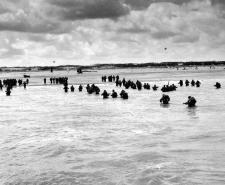
Episode 13: Operation Overlord
When should the Allies send their armies into France and on to Germany? The Allies spend years discussing the matter. Eventually, they decide on a place and time for the cross-channel invasion: Normandy, summer of 1944.
But the road to Operation Overlord - or D-Day, as it comes to be known - is no easy journey for Allied commander Dwight Eisenhower. He faces logistical challenges no-one has ever encountered before.
And Hitler is not naive to this plan, shoring up defences along the coast. For the Allies, it’s a race against the clock, and the weather report, to pull off one of history’s largest, most complicated military operations.
Episode 14: Home Fronts
Axis powers Germany and Japan are ostensibly tied together in war, but their civilian populations have vastly different experiences on the home front. Hitler and his propaganda minister Joseph Goebbels do everything they can to shield the German people from the war. In sharp contrast, Japanese Prime Minister Hideki Tojo asks his people to sacrifice more and more.
But as the tide of the war turns against the Axis in 1943, both governments’ demands of their people will grow more intense - and deadly.
Episode 15: Asian Armageddon
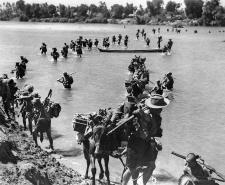
Japan’s quest for a pan-Asian empire has resulted in a brutal war against China. Japan has also embarked on a campaign of conquest across Southeast Asia, overtaking European and American colonies along the way.
By early 1944, the Allies are preparing to claw these territories back. Unbeknownst to them, however, the Japanese have designs on the crown jewel of the British Empire — India.
Episode 16: Liberation
The war in Europe is thought of by some as a war of liberation - the Allies are striving to free European peoples from Hitler’s tyranny. In the summer of 1944, the people of Paris are liberated from Nazi rule with the Allies’ help.
However, resistors in Poland, fighting for their freedom from German rule and eventual Soviet occupation, get no aid from Allied powers that summer. Instead, they are brutally crushed, the people subjected to the most horrific of Nazi treatment.
Those living and dying through the Holocaust fight every day for their lives, freedom and dignity. Some survive long enough to see an Allied army open the gates of their camps.

Episode 17: No Surrender
The campaign in the Pacific is a costly series of battles from 1944 to 1945. Americans and Japanese fight over islands scattered across the ocean, from the Philippines to Iwo Jima. But while the Allies are gaining decisive victories and drawing closer to mainland Japan, the Japanese will not surrender one inch.
Instead, the Japanese throw themselves ferociously into each fight. The perfect demonstration of this never-say-die spirit comes when the Japanese kamikaze fighters begin their assaults.
President Roosevelt and his commanders realise they might have no choice but to bring the fight all the way to the Japanese home islands. It’s a campaign that will be bloodier than anything they’ve seen in the entire war so far.
Episode 18: Vengeance
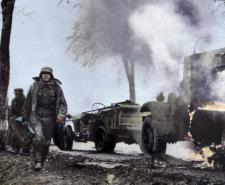
As American and British armies advance across western Europe towards Germany, Hitler plans one last offensive attempt through the Ardennes forest. The resulting Battle of the Bulge pushes Allied soldiers to the brink just as the war seems to be coming to a close.
At the same time, the Soviet Red Army is swiftly moving across Eastern Europe, aiming to fulfill Stalin’s wish of overthrowing Hitler and sacking Berlin. When Hitler’s last stand turns to failure, the German chancellor pays the ultimate price at his own hands, and Berlin falls.
Episode 19: Endgame
In early 1945, Americans are closing in on the Japanese home islands with the invasion of Okinawa. All the while, newly sworn-in President Harry S Truman is faced with an agonising decision. Should he invade the Japanese mainland at what would be a terrible cost to American lives?
Japanese Emperor Hirohito would also like to avoid the destruction of his land and people, but his generals are agitating for war. Both men will seek a way out of a costly invasion. Only one, though, has the option of using a weapon so powerful that when it’s used, it will change the world forever.
Episode 20: A New World Order
The war is over by September 1945, and Europe and large swaths of Asia are left to pick up the pieces. On the other hand, the United States and the Soviet Union are in ascendant positions as post-war superpowers.
Over the course of the next few years, these two nations will go from Allies of convenience to adversaries. President Truman and Premier Stalin pursue vastly different theories and objectives of what world power means.
You can expect us to return to the subject of World War II time and time again. So, why not subscribe to the Sky HISTORY Newsletter for updates on exactly what’s coming up and when.


