
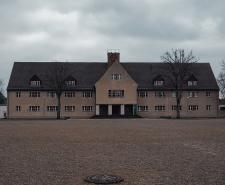
World War II: The Wola Massacre
The Wola Massacre was one of the most disturbing events during World War II. Read on to find out more.
Image: German soldiers standing in front of the Ursus factory, where almost 6,000 residents were executed | Public Domain

World War II was a harrowing period in human history, with millions upon millions of deaths. While the Holocaust is the most prominent event that comes to mind, there were also plenty of other horrific atrocities.
One particularly brutal event that occurred during World War II was the Wola Massacre. This massacre is deeply disturbing, involving the planned execution of thousands of Polish civilians. Join us here at Sky HISTORY as we dive deeper into the horrors of the Wola Massacre.
What is the Wola Massacre?
The Wola Massacre was the systemic slaughter of the Polish people within the Wola area in the Polish capital of Warsaw. Lasting from 5th August to 12th August, 1944, somewhere between 40,000 and 50,000 Polish people were executed during the massacre.
Hitler entrusted Heinrich Himmler, leader of the SS, to regain control of Warsaw, while Oskar Dirlewanger and Heinz Reinefarth were the major culprits. It is thought that during a meeting, Hitler orally commanded Himmler and General Heinz Guderian to eliminate everyone they could. He was rumoured to have said, 'Kill anything that moves.' Well-known German forces took on the task of murdering the people of Wola, including the Kaminski Brigades and the Dirlewanger.
The brutality of the massacre makes it particularly disturbing. No one was spared. Women, including pregnant women, children, babies, and the elderly, were all in the line of fire. While many were killed immediately, some were sexually assaulted and/or tortured before they were murdered. Some were even burned alive.
Other acts of brutality included grenades being launched into basements where civilians were hiding, and children being tossed into burning buildings with their mothers.
There was also no mercy for hospitals, orphanages or churches. German soldiers entered hospitals and murdered the patients while they were still in their beds. Not only that, but they also killed the nurses and doctors looking after them. Many children from the Orthodox Orphanage were murdered, with at least 20 victims. Some suggest that there could have been almost 100 child victims from the orphanage.
The bodies of the victims were piled up and ordered to be burned so that there would be no evidence of the massacre. So many were burned that 12 tonnes of human ashes were discovered once the Germans left Warsaw. That is why it is difficult to know the exact number of victims. It was also difficult to know how many were killed, as there were so few survivors left who witnessed the atrocities.
Why did the Wola Massacre happen?
The massacre came about as an act of retaliation against the Warsaw Uprising. This uprising was a significant operation during the war, organised by the underground resistance within Poland. The group's mission was to free Warsaw from German occupation. The event was a disturbing attempt to crush any morale that the Polish Resistance might have had left.
The aftermath of the Wola Massacre
Although Wola’s infrastructure was shattered and the population dwindled, the massacre did not have the effect that Hitler hoped for. Instead, the Polish Resistance was strengthened. They realised that surrender meant death, so the determination to fulfil their mission was bolstered.

Survivors of the Wola Massacre
Things were grim for the survivors of the massacre. Anyone left was either immediately executed or forced to toil in a labour camp. That being said, there were a few who did manage to escape. Let's take a look at some of these survivors, their ages when the massacre occurred, and how they avoided certain death.
- Apolonia Żabicka, née Fronczak: age 55
Apolonia played dead and stayed under the corpse of a man for a whole day. When she finally emerged, she found the bodies of most of her family.
- Bernard Filipiuk: age 44
Bernard also pretended to be dead and stayed hidden within a pile of corpses. He witnessed a woman beg for her baby to be killed first, but the soldier did not comply and shot her first. Bernard recounted hearing the baby crying for a long time afterwards.
- Józefa Marczak: age 47
Józefa saw her children and her husband killed before she fell to the ground. She had been shot in the left arm. Józefa played dead and was able to survive.
- Wanda Lurie: age 33
Wanda was nine and a half months pregnant and hiding in a basement with her three children. The family were taken to an execution site where she and the children were shot. However, Wanda was not killed. She lay among the bodies for days, seeing everything going on around her. Miraculously, she survived and gave birth to a baby boy on 20th August 1944.
- Wiesława Chełmińska: age 13
13-year-old Wiesława witnessed the execution of her mother before she was shot in the shoulder after being forced to climb a pile of corpses. She played dead until she realised the SS were gone.
The Wola Massacre is a truly sickening event from World War II. What was worse was that none of the German forces involved were prosecuted, nor were they held accountable. Despite this, the victims are still remembered in various ways. This includes the Wola Massacre Memorial, a large cross that accompanies various memorial plaques. The memorial is located at 32 Górczewska Street in Wola, and serves as a memory to the thousands of lives lost.
If you want to stay up to date on a range of historical topics, then be sure to subscribe to the Sky HISTORY newsletter. By doing so, you’ll get exclusive access to all our latest content.


