
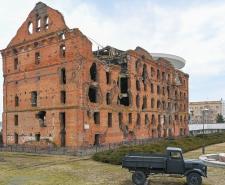
The Battle of Moscow: How the Eastern Front was really won
How did Nazi Germany lose World War II? One major mistake was invading the Soviet Union, with Hitler’s forces coming a cropper at the Battle of Moscow.
Image: Public Domain
The way the story of World War II is often told over here, it can feel like a strict case of Britain vs Germany. While Britain certainly did play a major role in defeating the Nazi scourge, it can be too easy to overlook the Soviet Union’s contribution.
Perhaps one reason why is that much of the Soviet tussling with Germany was on World War II’s Eastern Front. However, the fighting in this far-flung area was actually responsible for most of the death toll in the war’s European theatre.
As early as 1941, Germany invaded the Soviet Union, but found the Red Army a surprisingly tough nut to crack. As Sky HISTORY’s World War II with Tom Hanks hits screens later this month, we consider the impact and legacy of the Battle of Moscow.
What was Operation Barbarossa?
In September 1939, Nazi Germany invaded Poland, kicking off World War II – but Germany certainly wasn’t the only country with an appetite for expansionism. The following November, the Soviet Union encroached on Finnish territory in the Winter War.
Not that this Baltic conflict turned out to be the best advert for the Soviets’ military prowess. Their soldiers were ill-equipped to handle the cold, while their green uniforms hardly camouflaged them on the white snowy battlefields.
Though the battle ended in a stalemate rather than outright defeat for the Soviets, their inept showing had much wider repercussions. It convinced Adolf Hitler that the Soviet Union would be laughably easy to conquer.
The German chancellor launched Operation Barbarossa in June 1941. Hitler sought to not only destroy communism but also carve out new Lebensraum (‘living space’) for Germans to occupy in the east.
How the Nazis surprised the Soviets
Though Soviet premier Josef Stalin was warned that a German invasion was incoming, he didn’t believe it. Just two years earlier, he had agreed to the Molotov-Ribbentrop Pact, a nonaggression pact with Nazi Germany. Why would Hitler now break this vow?
It was a very good question – but, despite the pact, Hitler found the Soviet Union’s immense resources too tempting a prize not to compete for. He went as far as dividing his invasion army into three groups. One would capture the city of Leningrad and another Minsk and Smolensk, while the third group would head to Kiev.

So, when more than three million Axis troops penetrated Soviet territory on Hitler’s orders, the Soviets were taken by surprise. This gave German forces a major advantage as they marched hundreds of miles into Russia, along the way dispatching and capturing disorganised enemy soldiers.
The Battle of Moscow gets underway
Though the Germans did seize Smolensk in July 1941, there remained pockets of Soviet resistance in Leningrad and Kiev. Hitler decided to face down these before authorising further moves towards Moscow. This two-month interlude gave Muscovites valuable time to fortify their city.
Ordinary civilians dug anti-tank trenches, while Stalin recalled troops from Siberia, where the Japanese were no longer deemed a threat. This swelled the Red Army’s ranks on the Eastern Front, where they now outnumbered the Germans. As the latter approached Moscow, they also struggled to traverse muddy roads dampened by heavy rain.
While the Soviets’ Finnish adventure had taught them how to work the frosty conditions to their advantage, German forces were ravaged by frostbite. Like his idol Napoleon Bonaparte almost 130 years earlier, Hitler paid a heavy price for failing to subdue the Russians before winter. In this instance, it was one of Russia’s most brutally icy winters on record.
Hitler suffers a humiliating defeat
German troops got within 20 miles of Moscow before coming up against the Russians’ stubborn defensive lines. Though the Germans did launch sporadic air raids on Moscow, Stalin had relocated much of its manufacturing base to the Ural Mountains further east.

From this safe distance, weapons factories were able to easily replenish Soviet armies’ supplies as and when called upon. The Germans’ own supply lines were perilously overstretched. It didn’t help that Soviet forces retreating towards Moscow had, along the way, stripped the land of resources the enemy could otherwise have drawn upon.
In December, a Soviet counteroffensive pushed the Germans back. The Battle of Moscow was a major turning point in WWII, as it proved that Hitler’s forces could be beaten on land. This would prove crucial to the Allies’ morale as the Nazis continued running rampant across Europe until D-Day.
The Battle of Moscow was just one of many proud Soviet military campaigns, as you can find out by subscribing to the Sky HISTORY newsletter.


