
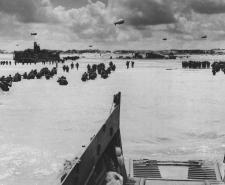
Operation Torch: The Allies’ triumphant North African campaign in WWII
How did the Allies win World War II? Operation Torch, which took Allied forces across the deserts of North Africa, was an underrated step towards victory.
Image: General Dwight Eisenhower points to a map during Operation Torch planning | World War II with Tom Hanks
When you think of major World War II campaigns, you likely think of its Eastern Front, which claimed a staggering 30 million deaths. However, as the war continued to rage, both sides also increasingly saw North Africa as a desirable prize.
Britain already had a stake there, maintaining its own garrison in Egypt to protect the crucial supply route of the Suez Canal. Heads were also turned by the region’s immense oil fields. What use were mechanised tanks if there wasn’t enough fuel to keep them running?
And so it was, that in November 1942, the Allies launched Operation Torch, with Anglo-American forces landing on the North African coast. The ensuing mission was so tumultuous and eventful, the new Sky HISTORY series World War II with Tom Hanks devotes an entire episode to it. So, what challenges awaited the Allies in North Africa?
The battle for North Africa
The British began their North African campaign in 1940, but struggled to overcome the troops stationed there by Benito Mussolini’s Fascist Italy. Another constant thorn in the side of the British was the daring German commander Erwin Rommel.
By the time 1942 came around, British Prime Minister Winston Churchill had begun talks with US President Franklin Delano Roosevelt. The United States had entered World War II after the attack on Pearl Harbour and decided to team up with the British against the Axis.
The only question left was exactly what form the first Anglo-American military expedition of the war should take. Though the Americans had proposed landing in Europe, Churchill knew that the US still needed to build up its military might.
North Africa, he felt, would be the ideal place for American troops to warm themselves up before entering more challenging theatres of the war. Churchill also knew that Soviet Union premier — and fellow Allied leader — Josef Stalin had his hands full on the Eastern Front. A new front in North Africa would hopefully alleviate this pressure.

Montgomery and Rommel clash in Egypt
Operation Torch was preceded by the two Battles of El Alamein in 1942. In both, Allied forces halted Rommel’s attempts to lead his troops further into Egypt. The Second Battle of El Alamein, which took place from late October to early November, was an especially spectacular triumph for the Allies.
The clash saw General Harold Alexander and Lieutenant-General Bernard ‘Monty’ Montgomery take the reins of the British Eighth Army. These soldiers successfully broke through Rommel’s line, leading the German Field Marshal to flee with his Axis troops.
For the Allies, this victory wasn’t just a valuable morale boost after a string of humiliating reversals at Rommel’s hands. It also provided promising conditions for Operation Torch, which would begin on 8th November. Rommel’s defeat forced his men to retreat to Tunisia and Anglo-American soldiers approaching from the west would later hem them in there.
Operation Torch gets underway
When France fell to the Nazis in 1940, the UK lost a valuable ally. However, the Nazis didn’t quite cement complete hegemony over France. Parts of the country outside the invaders’ direct control made up Vichy France, which itself held North African colonies.
So, the Anglo-American troops would inevitably come up against Vichy French forces when marching across North Africa. Operation Torch saw three separate task forces land in different parts of the continent. Two American forces targeted Casablanca and Oran, while a British force had Algiers in its sights.
The Axis powers are pushed out of North Africa
In theory, Vichy France was a Nazi puppet state. In practice, however, its loyalty to the Nazis proved somewhat fluid. Indeed, when the Allies sounded out a number of French officers based in North Africa, they got an encouraging response.
Just days after the 107,000 British and American troops landed, Vichy French authorities signed an armistice with the allies. When German chancellor Adolf Hitler got word of this capitulation, he ordered the Nazis’ occupation of Vichy France.
In a late swipe at the incoming Nazis, Vichy France scuttled the French fleet at Toulon. The Allies’ dominance of North Africa enabled them to expel the Axis from the region in May 1943. The Allies also went on to use North Africa as a springboard to invade Italy — in Churchill’s words, the ‘soft underbelly’ of Europe.
The success of Operation Torch was just one of many milestones for the Allied powers in World War II. To learn more about the trajectory of this global tussle, sign up for the Sky HISTORY Newsletter.


