
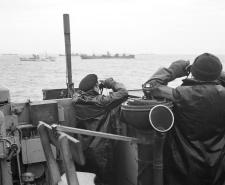
D-Day: The true story behind 'Pressure'
Was the Nazis' hold on occupied France undone by the weather? Largely, yes, as the new film Pressure shows. But does it get the history right?
Image: Meteorologist James Stagg is portrayed by Andrew Scott in the new film 'Pressure' | Public Domain
Many drama films over the years have vividly depicted D-Day, the famed ‘beginning of the end’ for the Nazis’ occupation of Europe. However, not all have gone into forensic detail about the behind-the-scenes planning that ensured the Allied forces touched down at just the right time.
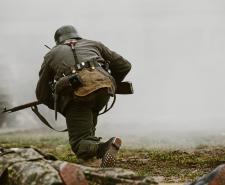
The action that unfolded on the northern French coast in June 1944 has been recreated in films like Saving Private Ryan and The Longest Day. The Normandy landings, though, might not even have happened had the notoriously volatile weather engulfing the English Channel not played ball that particular day.
As for why it actually did, we can thank one crucial last-minute call made by one of the Allies’ senior meteorologists, James Stagg. He insisted that the start of ‘Operation Overlord’ be delayed by 24 hours to take advantage of better weather conditions. The spectacular payoff is dramatised in the new film Pressure, starring Fleabag’s Andrew Scott as Stagg. How closely does it adhere to the real story told in Sky HISTORY’s World War II with Tom Hanks?
The tortured, complex planning of D-Day
When Germany invaded Poland in September 1939, it was just the start of a long string of Nazi conquests in Europe. Within a year, large swathes of the continent, extending as far west as Belgium, Norway and France, had fallen to the Nazis. Britain was the next domino for the Nazis to tip over, or so they thought. The Battle of Britain foiled German leader Adolf Hitler’s attempts to gain the air superiority he needed to cripple his foe across the Channel.
Britain also wasn’t the only unconquered nation determined to halt the ferocious Nazi advance. Much of the early fighting in World War II actually took place on the Eastern Front. As a result, the Soviet Union urged fellow Allies the United Kingdom and the United States to open up a second front against the Germans. Eventually, the UK and US decided to spearhead an invasion of Nazi-occupied France. The only major question left was when they ought to pull the trigger.
Allied commander Dwight D Eisenhower pencilled in a projected invasion date of 5th June 1944, on account of the favourable weather expected that day. It wasn’t long before Stagg threw a spanner into the works. He predicted that a storm would hit the Channel on that date but fade soon enough for Allied forces to safely cross the following day. An anguished Eisenhower reluctantly shifted the scheduled start of the operation to 6th June, and the rest, as they say, is history.
What does Pressure get right about the D-Day preparations?
The film accurately captures the fraught indecision that struck Eisenhower in the days running up to the Normandy landings. In his role of planning Operation Overlord, Eisenhower had to weigh up several factors as he struggled to determine the optimal launch date. For example, the waves would have to be gentle enough not to capsize the Allied navy vessels. Ideally, there would also be a full moon as dawn approached, with the added illumination helping Allied forces to more easily see German-built coastal defences.
Nonetheless, history professor Jared Frederick does take issue with Pressure’s portrayal of Eisenhower, played in jarringly hotheaded style by Brendan Fraser. ‘Eisenhower could have quite a temper,’ Frederick comments on his YouTube channel Reel History. Still, Frederick believes that only some of Eisenhower’s closest associates would have witnessed the full extent of the rage he was truly capable of. In reality, Eisenhower appears to have had a very genial relationship with Stagg and taken his advice seriously.
One of Pressure’s truer-to-history elements is the tension seen between Scottish-born Stagg and American meteorologist Irving Krick. Played by Chris Messina in the film, Krick insists that the weather will be fine for the invasion force to set sail on 5th June. However, Krick’s methods entailed analysing previous weather patterns, while Stagg relied more heavily on readings sourced from weather stations across the Atlantic. In the end, Eisenhower deems Stagg’s forecast more reliable.
Like in the film, Stagg’s wife was indeed pregnant during D-Day. In an attempt to heighten drama, the script adds the fictitious detail of a German bomber attacking the hospital where she is staying. Also, while Pressure sees Stagg’s wife (played by Tamsin Topolski) give birth straight after D-Day, the actual birth was several months further down the line.
How do other war films fare against the real history? Sign up to the Sky HISTORY newsletter to judge for yourself. Every week, you'll receive the latest articles, episodes and more delivered straight to your inbox.


