

Guising: The old Scottish Halloween tradition
Guising is Scotland’s Halloween tradition: children dress up and perform a ‘turn’ for treats. Here’s its history, from Samhain to trick-or-treating.
Image: stock.adobe.com
If you love spooky stuff, Halloween could easily be a highlight of your year. It’s the ideal excuse to dress up as a witch, werewolf, mummy or whatever other creepy character floats your boat. You’ve likely even got childhood memories of doing exactly that for nights of trick-or-treating.
If you’re Scottish, though, you might not remember calling it trick-or-treating. North of the border, the Halloween practice of turning up in macabre fancy dress on other people’s doorsteps is traditionally known as ‘guising’. So, is trick-or-treating essentially just guising rebranded? Not quite…
True, both are fun ways to amass sweets or money from kind strangers. However, guising comes with many unique customs of its own. It’s been around for centuries, and is still practised by many Scots to this day. Sky HISTORY looks at how guising began in Scotland, how it differs from trick-or-treating, and how it has survived to this day.
The misty origins of guising in Scotland
Halloween as we know it today is thought to have grown out of the ancient Celtic festival of Samhain. As October gave way to November, the boundary between the physical world and the spiritual realm was thought to be at its most porous. In theory, this was when spirits could too easily slip into our world, perhaps not always with the best of intentions.
So, around this time of year, Scots observing Samhain would engage in various rituals aimed at protecting themselves from the wrath of demonic entities. These precautions would include disguising yourself as a ghost when leaving the house. That way, if any evil spirits did catch sight of you, they would hopefully just think you were one of them and leave you alone.
Of course, ideally, you’d just stay indoors, in which case, you would still leave food on display outside to appease any nefarious ghosts hanging around. In the event, pretend ghosts, yes, living, breathing Scots simply disguised as ghosts, wouldn’t be able to resist pouncing on those nibbles. Was this the beginning of guising in Scotland?

How did guising in Scotland develop?
We can’t be certain exactly when the practice first came about, but the earliest known record of guising in Scotland dates back to the 16th century. The term ‘guising’
is itself derived from the word ‘disguise’, as putting on weird clothing was a key part of the guising equation.
In their ghost outfits, guisers would call at people’s homes to request food, such as fruit and nuts. These would be given to help the guisers keep the ‘real’ spirits at bay. At the same time, they wouldn't simply be handed out willy-nilly. Rather, the guisers would have to put on some kind of performance first, like a song, dance or poetry recital.
In this sense, guising in Scotland was slightly more complicated than trick-or-treating as we know it today. Nonetheless, it may have inspired the latter when, in the 19th century, Scots emigrated to North America and took their ingrained Halloween customs with them. Though guising is known to have still been a thing across the pond in the early 20th century, it slowly fell out of favour.
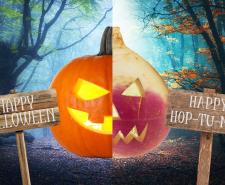
Do people still go guising in Scotland today?
Yes, even if many Scottish kids today are missing out on the fun. In a recent study, 64% of Scottish adults felt that guising had fallen in popularity since their own childhood years. Still, some longstanding guising traditions are said to have lingered in certain regions.
On the island of Berneray, children visit strangers every ‘Oidhche Challain’ (Old New Year) to spread good wishes. For centuries, Shetland Islanders have had their own take on guising, ‘skekling’, going from door to door in distinctive straw costumes.
More often, though, you’ll see elements of both trick-or-treating and guising in Scotland today. So, if you want to practise guising, what’s the secret to getting the most out of it? According to the research, tickling the funny bone.
In the survey, 56% of Scots said they would expect a guiser to tell them a good joke. Only 11% would look forward to hearing them sing, while 2% would want them to recite a poem. When guisers do go down the poetry route, perhaps they ought to quote from national icon Robert Burns, who famously wrote of historical Halloween traditions.

For more on how Britain’s Halloween customs have changed over the centuries, sign up to the Sky HISTORY newsletter. Every week, you’ll receive the latest articles, episodes and more delivered straight to your inbox.


