
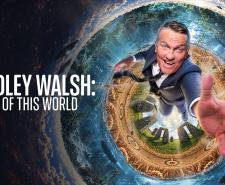
‘What I’ve seen is incredible’: Interview with Bradley Walsh on 'Out of this World'
Bradley Walsh talks UFOs, Rendlesham Forest and the search for Atlantis ahead of his new Sky HISTORY series Out of this World, airing from 3rd November.
Image: Bradley Walsh: Out of this World
Are we alone in the universe? Did Atlantis ever really exist? What’s the truth behind Stonehenge? If you’re as fascinated by some of our planet’s greatest mysteries as Bradley Walsh is, you’ve probably pondered these questions before. Maybe you have your own theories.
But very few of us actually get a chance to find the answers, or speak to people who know. That’s why, fresh off his adventures in Egypt’s Cosmic Code, Bradley set out on a new mission to uncover the truth.
In Bradley Walsh: Out of this World, the popular presenter explores some of the greatest mysteries on and beyond our planet with his trademark humour, curiosity and infectious enthusiasm. Ahead of his new show airing exclusively on Sky HISTORY from Tuesday 3rd November, he joined us to share what he’s discovered.
A desire to seek answers
Just as was the case for Egypt’s Cosmic Code, Bradley’s motivation for the new series stems from a blend of curiosity and healthy scepticism. He explains that while he’s never seen a UFO before, he was keen to speak to people who claimed they had, to properly understand accounts that have often become fragmented over the decades.
‘Since post-war, you've seen snippets of articles in newspapers across the decades of these sightings, but not everyone has condensed it all and put it all together. People are quite happy with going, “oh, that happened in the 1950s, that happened in 1970”, et cetera. But somehow, there's maybe a correlation between them, and not everyone has worked that out, and not everyone has brought that under the public gaze, and I wondered why.’
In recent years, UFOs have made headlines on both sides of the Atlantic. In the US, former military personnel have testified under oath before Congress, with ex-intelligence officer David Grusch claiming in 2023 that the government was hiding a crash retrieval programme. Meanwhile, in the UK, newly released Ministry of Defence files have revealed further striking evidence of UFO activity.
But despite the revelations, the news has rarely cut through and captured people’s attention for long. For Bradley, the muted public response is one that he finds hard to understand.
‘There are really credible people that have seen unexplained sightings. But we live in an age where we’re more interested in what pair of shoes one of the Kardashians wore than what a Lieutenant Colonel is saying that they saw,’ he muses.
Of course, part of the reason why those UFO news stories have generated less interest than you might expect is the public scepticism that still exists towards reported UFO sightings. Bradley admits to being ‘on the fence’ before filming Out of this World, but adds that he has been struck by the accounts of those he has spoken to throughout the four-part series.
‘My job is to sit on the fence and be, in a way, the jury for the people. To speak to these people and listen to them,’ he explains about his role in the series. ‘I haven't seen anything, and seeing is believing. But I have to tell you, some of what I’ve seen, witnessed and the people that I’ve spoken to is incredible.’
‘I’ve always said this, when you’re looking at someone and they’re speaking to you, you can usually tell instinctively if they’re telling the truth,’ he adds. ‘And if these people – who I believe are very credible – aren’t, then they deserve a double Oscar.’
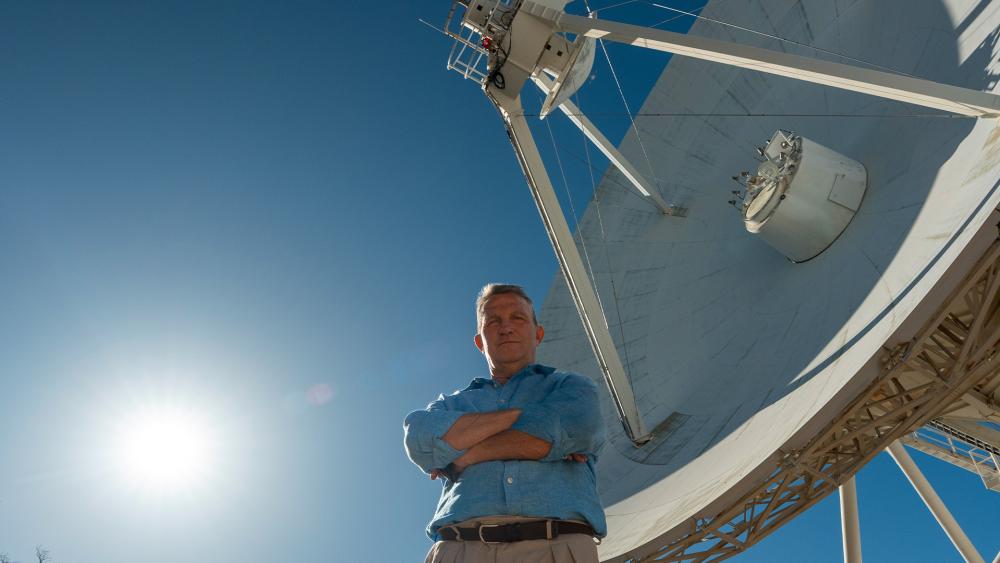
Image: Bradley Walsh: Out of this World
Investigating the Rendlesham Forest incident and the Phoenix Lights
In the first two episodes of his new series, Bradley delves into Britain’s declassified Ministry of Defence files, before heading to Rendlesham Forest – the scene of the country’s most famous alleged UFO incident.
It’s often described as Britain’s Roswell, and Bradley was provided with first-hand testimony from Lieutenant Colonel Charles ‘Chuck’ Halt about what he saw on those fateful nights in December 1980. The testimony is just one of many compelling pieces of evidence that Bradley is provided with, and leaves a lasting impression.
‘I've read the transcript and I've listened to the radio transmission from that day, and it's extraordinary. Really extraordinary,’ Bradley says. Later, Halt presents him with a plaster mould of a footprint from one of the tripods of the craft. ‘Now that's a Lieutenant Colonel in the US Air Force in charge of the regulation. He's a top boss. I don’t know if it’s real, but I also think that he’s not going to lie, and why would he make it up?’

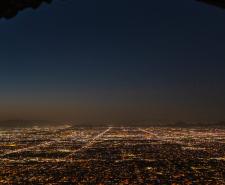
Another highlight of the series sees Bradley travel to Phoenix, where, in March 1997, a series of widely sighted unidentified flying objects were observed in the skies over Arizona and Nevada. The incident has been hotly debated ever since, but after speaking with several of those who reported the sightings, Bradley came away believing they had experienced something that has no simple earthly explanation.
‘We went to see a former doctor, Dr Lynne Kitei, who gave up her career as a doctor after seeing these lights sitting on the side of a mountain overlooking Phoenix Airfield, and couldn't understand what was going on. She gave up her career to follow this anomaly. She was very passionate about what she saw. Apparently, what she saw was the size of a football field, hovering around the airfield. She sees it, as do thousands of other people.’
‘The government pooh-poohed it until someone on the ground radioed to the tower saying that they weren’t able to take off,’ he continues. ‘You know who that person was that radioed in? It was Kurt Russell, saying that he couldn’t take off or get his plane off the ground. I don’t know what it was for sure, but I believe that these people saw what they said they did.’
From Stonehenge to the search for Atlantis
Out of this World isn’t purely focused on UFOs. Later in the series, Bradley heads to Stonehenge, a site that held more significance to him following Egypt’s Cosmic Code. Purportedly, Stonehenge was constructed around the same time as the Pyramids. But as Bradley is quick to point out, there’s one key difference.
‘The Egyptians are better builders than the Brits! That's the end of that conversation. That's it. Bless them. The Brits, they've tried hard, but it's not a pyramid,’ he laughs.
Just as with the Pyramids, there still remains an enduring mystery about Stonehenge – why and how it was built – that continues to captivate 5,000 years later.
‘We’re still not sure of how it came to be and of its significance. Some of the stones were thought to have been carried from close to Wales, one of the stones potentially as far as the north of Scotland. It’s believed to be related to the Equinox, something that Egyptians were very interested in too. I think there’s a big rabbit hole of mysteries with Stonehenge, some perhaps true and some perhaps not, but it’s the mystery of it all.’
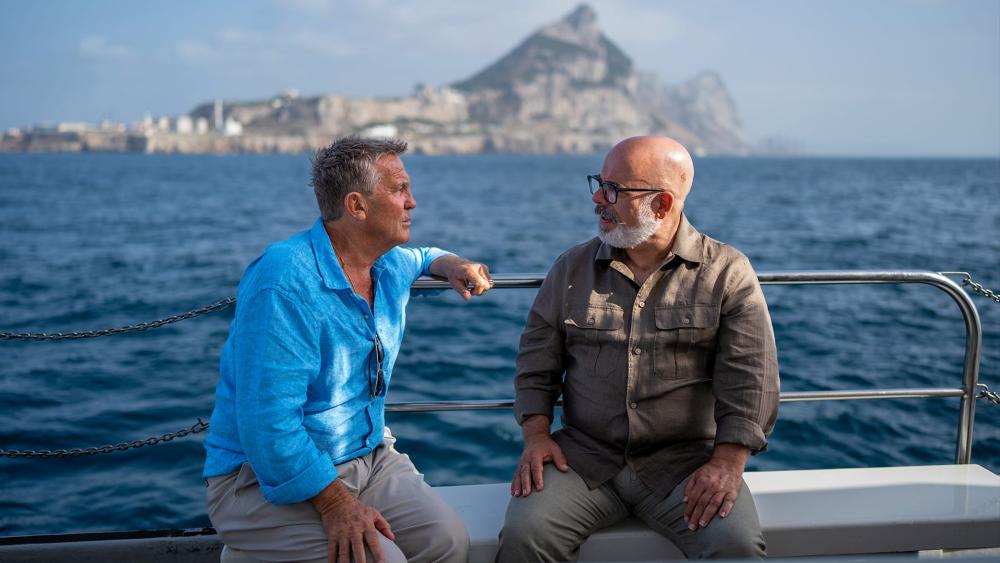
Image: Bradley Walsh talks to Tony McMahon during his hunt for Atlantis | Bradley Walsh: Out of this World
But perhaps the greatest enduring mystery of all is that of Atlantis – the lost continent first mentioned by the Greek philosopher, Plato, in 360 BC. Over the centuries, many researchers and explorers have dedicated their lives to locating Atlantis and proving it was more than just a myth. In Out of this World, Bradley teams up with historian Tony McMahon to learn more about Plato’s clues.
‘People say that Atlantis is anywhere from on top of a mountain in the Philippines to Tasmania to Epping Forest or somewhere daft. However, Tony says to me, “Look, you’ve got to go to Cadiz”. And there I meet Michael Donnellan, who truly believes that through Plato’s writing they have discovered the location of Atlantis. With divers exploring the site and high-tech cameras imaging the lost city exactly as apparently described in Plato’s writing.’
Of all the evidence that Bradley is presented with throughout the series, he cites seeing sonar images of the walls of Atlantis as the most convincing.
‘The water's not very clear, of course, and you literally have to go as close to my hand and take a photograph of it. You’re practically touching it. It's just extraordinary. I didn't expect this journey to be the journey it was.’
The importance of keeping mysteries alive and the next adventure
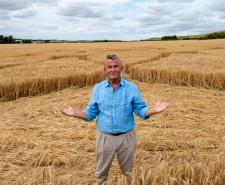
Out of this World attempts to uncover answers for many of our greatest mysteries, from ghost rockets to crop circles. Yet Bradley stresses the importance of keeping some as just that – mysteries.
‘I think it's probably better to have the mystery and let it roll on,’ he argues. ‘I think that's great because the danger is that all of a sudden you find Atlantis, you announce that you found it. That tiny place, wherever it is, off the coast of Spain, all of a sudden becomes some great attraction or commercialised theme park of sorts. It opens up a Pandora's Box of sorts where inevitably people will look to monetise things and the mystery is lost.’
‘I think we need a little mystery, so I’d like to keep it going,’ he continues. ‘I've thoroughly enjoyed my journey. Am I convinced by all of this? Still no. Why? Because I haven't actually seen anything with my own eyes. But I'm erring on the side of perhaps these things have happened because who I’ve spoken with have all been so earnest about it.’
Despite his healthy scepticism, it’s clear that the series – and his Atlantis experience in particular – has further piqued Bradley’s curiosity. Now something of a veteran explorer, he concludes with where he’d like his next adventure to take him.
‘We spend a lot of our time looking up. Why don't we look down? And what I mean by that is, there's so much more to see under our oceans and our waters. Who knows what is happening down there!’
Don’t miss Bradley Walsh: Out of this World, airing exclusively on Sky HISTORY from Tuesday 3rd November. Want to explore more of the stories featured in the show? Sign up to the Sky HISTORY newsletter today. Every week, you’ll receive the latest articles, episodes and more delivered straight to your inbox.


