
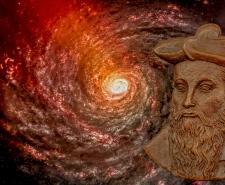
Why are humans obsessed with predicting the future?
Historian Tony McMahon tries to get to the bottom of why it has been long believed that there are a select few humans with soothsaying abilities.
Image: Tony McMahon is an investigative historian, author and journalist
In this guest article, investigative historian, author and journalist Tony McMahon explores why humans have been obsessed with prophets and prophecies throughout history. Are there really gifted people who can see into the future, or is it simply something that we just want to believe in?
For millennia humans have hung on the words of prophets who claim to see the future. We are fascinated by those individuals who appear to possess a special gift for predicting what’s just round the corner. And every year sees new prophets emerge to thrill us with their revelations. According to experts, our addiction to prophecy is booming as the world becomes more dangerous.
In the last couple of years, Athos Salomé has been proclaimed as the ‘living Nostradamus’ by his followers. He’s a Brazilian parapsychologist and soothsayer who foresaw the Covid pandemic, Elon Musk buying Twitter, and the death of Queen Elizabeth II. His predictions tend to have a very modern flavour, for example anticipating the cyber-attacks on the 2024 Paris Olympics and corporate espionage by North Korea.
As the world becomes increasingly volatile, and trust in experts is falling, millions of people are looking once again to old-fashioned prophets to see our future. Julie Green runs a YouTube channel with 245k subscribers and with reference to the bible, predicts corporate boardroom changes in Silicon Valley. Also on YouTube, you can watch self-help videos on how to unlock your own ‘prophetic gift’, unleashing your inner Nostradamus.
It's as if we are connecting with our ancestors who consulted the oracles in ancient Greece, the auguries in Rome, medieval sorcerers, and Victorian mystics. Hence the interest in psychics like London-based Nicolas Aujula who believes that World War III is imminent and predicted the 2019 fire at Notre Dame cathedral in Paris, France. He also sees a reconciliation soon between Britain’s Prince William and his brother, Prince Harry.
However, the prediction game is a fickle business. The future may not turn out exactly as you prophesied. And the more clearly defined the prophecy, the greater risk for the prophet. Jeremiah Johnson, who runs a Christian ministry named after himself, told believers that Donald Trump would be re-elected in the 2020 presidential election. When that didn’t happen, there was severe blowback even if four years later, Trump returned to the White House.
Maybe modern prophets should take note of how Nostradamus did it. The way to minimise hostages to fortune lies in how you word your predictions. Basically, keep them as obscure as possible. Nostradamus (lived 1503-1566) remains the undisputed champion of prophecies in our age. It’s said, for example, that he had a terrible vision of the future 9/11 terror outrage in New York. But what exactly did the venerable sage write? Well, it went like this:
‘The sky will burn at forty-five degrees / Fire approaches the great new city / By fire, he will destroy the city / A cold and cruel heart, blood will pour / Mercy to none.’
There’s plenty of wiggle room in that verse for any number of calamities. Or take this example, that it’s claimed foretells the assassination of President John F. Kennedy in 1963.
‘The great man will be struck down in the day by a thunderbolt / An evil deed by those who have plotted/ From on high, evil will fall on the great man / The guilty one will remain in the mist.’

The language evokes the Book of Revelation, which ends the New Testament, and gives a colourful and apocalyptic view of how the world will end. It’s all a bit vague, full of symbols and metaphors, and open to multiple interpretations. His verses often draw on different languages including French, Latin, and Greek, creating made-up words and deliberate confusion. It’s this approach that has kept Nostradamus relevant and popular over the last five hundred years.
One key difference between those who see the future today and their counterparts in the ancient past is that while our ancestors were guided by prophets who claimed divine knowledge, today we’re more likely to listen to psychics with extra-sensory perception, intuition, or a connection to the spirit world.
In the digital age, prophets, seers, and psychics have the global social media platform to publicise their predictions. And they can tap into ever changing fads as well as our faster and looser relationship with the truth. But to retain a following, they need to be proven right. And their services are being called for in everything from business strategy to law enforcement and mass entertainment.

Boardroom directors have reportedly employed psychics to map out a company’s future trajectory. At the turn of a Tarot card, they prepare to make major investment decisions. Back in the 1980s, the infamous motor industry executive John DeLorean admitted asking a spiritualist to help future proof his business. And police departments, especially in the United States, have admitted to using ‘psychic detectives’ to provoke new lines of inquiry.
Sceptics scoff at the modern surge of interest in prophecy. They counter that many of the predictions about AI, future wars, cyber-attacks, pandemics, and so on can be found on news sites and learned journals written by people who do not claim to have psychic powers, just a grasp of geopolitics, economics, health, or other very earthly disciplines. All the prophets have done is add some very excitable language to more sober analysis already out there.
Well, whatever the sceptics say, those who can foretell our future remain popular. During periods of uncertainty, we seek comfort and assurance from those with the gift of prediction. Nostradamus has rarely been out of print since his death in 1566. Many more have come forward claiming similar powers. And we just can’t get enough of it.
Tony McMahon is an author and historian. His latest book - Downfall of the Templars: Guilty of Diabolic Magic? - is published by Pen & Sword and available on Amazon.


