
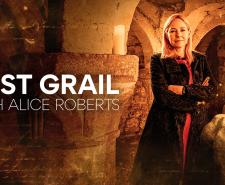
A historian asks did the Holy Grail come to Britain - and if so, where is it hidden?
In this guest article, historian Tony McMahon explores the numerous theories that the Holy Grail was brought to Britain, ideas he also investigated with Professor Alice Roberts in the Sky HISTORY series 'Lost Grail'.
Image: Tony McMahon helped Professor Alice Roberts in her hunt to find out what happened to the Holy Grail | Lost Grail with Alice Roberts
We’ve all heard of the Holy Grail – but what exactly is it? And more intriguingly, could this sacred relic, linked to the crucifixion of Jesus Christ, have found its way to Britain two thousand years ago?
I had the pleasure of working with Professor Alice Roberts on her three-part quest to find the most sought-after sacred relic in the world: Lost Grail with Alice Roberts. Like many explorers before her, Alice traversed the country in a valiant search for the truth.
The most popular theory about the Holy Grail is that it was a cup, or chalice, held by Jesus at the Last Supper, where he sat with his disciples for one last time. The wine it contained symbolised ‘the blood of the new and everlasting covenant’. In other words, Christ shedding his own blood for the forgiveness of all our sins.
This moment is reenacted in the Christian sacrament of communion where in Roman Catholic churches the wine is literally believed to become the blood of Jesus through the miracle of transubstantiation.
At the crucifixion, the same cup was used by a man called Joseph of Arimathea, said to be the great-uncle of Jesus, to collect drops of blood from his great-nephews wounds as he died on the cross. It’s always struck me as such an odd thing to do. As if he was getting a souvenir from this macabre occasion.
Joseph was reportedly a wealthy member of the Sanhedrin, the supreme Jewish legal body, based at the temple in Jerusalem. He recovers the body of Jesus and gives his grand-nephew a decent burial in a rock-hewn tomb, which enables the subsequent resurrection. In a way, he’s a plot device in the bible and nothing much more.
Yet the character of Joseph sprouted storylines over the centuries with him taking the Holy Grail on a long journey, leading to the shores of England. The poet William Blake drew on this legend for the lyrics of the popular hymn, Jerusalem: ‘And did those feet in ancient time, walk upon England’s mountains green?’
What brought him here? Alice investigated medieval claims that Joseph was a tin merchant. This may seem implausible but in fact, Cornwall and Devon were major sources of tin during the Roman Empire and this metal was hugely valued as a vital ingredient in making bronze, especially for weapons.
Tin traders travelled to the Isle of Wight, on England’s south coast, to load their precious metal onto boats bound for the European mainland. Alice chanced upon a local story that Joseph travelled from the Holy Land to the Isle of Wight, conducted his business, and then buried the Holy Grail into the white cliffs for safekeeping.
However, most of the medieval tales see Joseph journeying further inland to the county of Somerset.
According to legend, Joseph visited England years before and brought with him the young Jesus. This tale was one of several medieval attempts to fill in the missing years of Christ’s life story between his childhood and ministry. The village of Priddy in Somerset boasts that Joseph and Jesus searched for tin and lead deposits in the area. I went there in 2024 on a very rainy day and imagined the duo wanting to return as quickly as possible to the sunshine of Judaea.
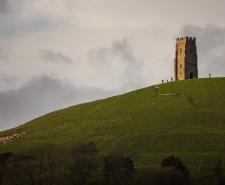
Then a forlorn Joseph returned to England after the crucifixion, clutching the Holy Grail. In the Middle Ages, the wealthy, and rather corrupt, monks at Glastonbury Abbey made the astonishing claim that Joseph founded their abbey as the first Christian church in the world.
When his walking stick struck the ground, it sprouted into a miraculous tree, the Glastonbury Thorn. It’s had an unfortunate history, to put it mildly. One of Oliver Cromwell’s puritan soldiers cut down the original tree in 1647 while a 1950s replacement was vandalised in 2010. As for the Holy Grail, it was buried at the Chalice Well, where the water still runs blood red (due to its iron oxide content, say sceptical scientists).
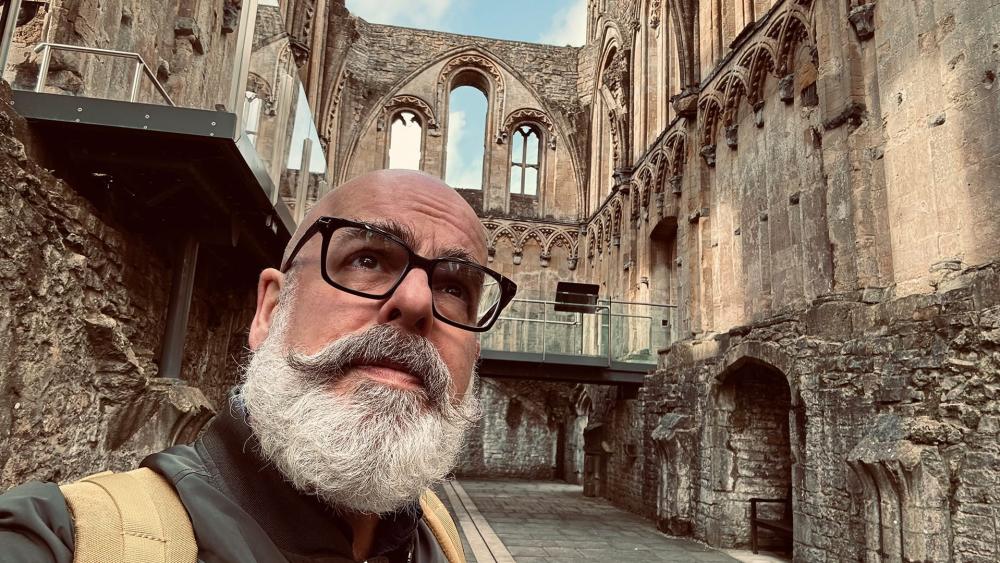
Image: Tony McMahon at the ruins of Glastonbury Abbey
Just in case the grail association failed to boost pilgrim numbers sufficiently, the monks discovered the bones of both King Arthur and Guinevere in the year 1191, just as they needed funds for major rebuilding work.
The legendary Arthur, with his Knights of the Round Table, were linked to the Holy Grail thanks to medieval authors like Chrétien de Troyes and Wolfram von Eschenbach. In their respective tales, the grail was either a serving dish or a magical stone. It took another Arthurian scribbler, Robert de Boron, to turn the grail into a chalice used by Jesus and link it to Joseph of Arimathea and King Arthur.
All the Arthurian romances feature fearless knights. Von Eschenbach’s mention of an order of warrior grail guardians named the ‘Templeise’ led to the real-life Knights Templar being cast as the true keepers of the grail. This is a legend I’ve investigated in my latest book, part of a trilogy about the knights, titled Downfall of the Templars: Guilty of Diabolic Magic?
Most of the theories about the Templars possessing the Holy Grail centre on the order’s dramatic downfall in the year 1307. This brotherhood of holy warriors, who lived like monks and showed utmost courage during the Christian crusades of the Middle Ages, were suddenly branded as heretics, traitors, and guilty of lewd initiation rituals.
In a series of dawn raids by King Philip IV of France, and sanctioned by Pope Clement V, the knights were rounded up, imprisoned, tortured, put on trial, and the leadership was executed by burning at the stake.
Theories have proliferated ever since that some Templars were tipped off about their impending doom and fled France with holy treasure, unearthed during their time in Jerusalem, making their way north to Scotland.
It’s argued they were protected by a local noble family, the Sinclairs, who may even have helped them escape Europe for the New World, using old Viking maps, a century before Christopher Columbus achieved that feat.
The Sinclairs were responsible for building Rosslyn chapel in the 15th century, an ornate structure not far from the Scottish capital, Edinburgh. On my last visit, it was standing room only as the guide gave a talk to church full of enraptured tourists.

Image: Tony McMahon taking at Rosslyn Chapel
Did exiled Templars bury the Holy Grail under the floor of the nave? Proponents of this theory point to visual clues in the chapel’s carvings. Tantalisingly in 1993, a mysterious wooden bowl was unearthed during excavations at Rosslyn. It’s a disarmingly simple object that one imagines could have been a carpenter’s cup in New Testament era Judaea.
Over the centuries, there are estimated to have been over 200 relics claiming to be the Holy Grail in different places around Europe. Today, the Spanish have two possible grail candidates with an agate cup in Valencia Cathedral and the Chalice of Doña Urraca at the Basilica of San Isidoro inLeón.
The Lost Grail documentary mentioned the so-called ‘Sacro Catino’, a green glass dish kept in Genoa Cathedral in northern Italy. When Napoleon Bonaparte invaded Italy in 1805, he ordered this Holy Grail to be sent to Paris for analysis. It was found to be 9th or 10th century Byzantine or Islamic in origin. During the examination, the French scientists managed to break the cup into ten pieces to the consternation of the Genoese.

Many have sought the Holy Grail including the Nazis. The SS leader, Heinrich Himmler, dispatched a German archaeologist, Otto Rahn, on an ill-fated grail quest around Europe from Iceland to Italy. Having failed to return with the sacred object, Rahn was found frozen to death on an alpine hillside in 1939 in decidedly suspicious circumstances.
As for why Himmler was grail obsessed, the blame lies in part with the opera Parsifal, composed by Richard Wagner, based on Von Eschenbach’s Arthurian story. Himmler hoped that by finding the grail, and other relics, he could make the Third Reich immortal and prove his bizarre theory that Jesus Christ was an Aryan.
The Holy Grail remains out of sight but not out of mind. We see its enduring cultural impact in movies from Indiana Jones and the Last Crusade (1989) to The Da Vinci Code (2006) and, more humorously, Monty Python and the Holy Grail (1975). To Christians, it’s a direct connection to the sacrifice of Jesus Christ. To the more secular-minded, it’s a good old fashioned treasure hunt featuring incredible characters and stories.
Tony McMahon is a TV historian and author of Downfall of the Templars: Guilty of Diabolic Magic? (Pen & Sword) where he discusses the Grail myth in more depth. He also co-hosts the Talking Templars podcast with Dr Steve Tibble.


