
5 little known facts about the Wars of the Roses
What do you know about the medieval tussle between the English royal houses of Lancaster and York? Here are some obscure facts about the Wars of the Roses.
Image: 'Plucking the Red and White Roses in the Old Temple Gardens' by Henry Payne | Public Domain
In 1399, Henry Bolingbroke deposed Richard II from the English throne, becoming Henry IV – England’s first monarch from the House of Lancaster. However, in the 1450s, Richard, 3rd Duke of York, a descendant of Edward III, began claiming the throne.
In 1461, Richard’s son was crowned as Edward IV, a member of the House of York. For about three decades, the Yorkists and the Lancastrians continued to compete for the throne. In popular imagination, the former are represented by a white rose and the latter a red rose – hence the ‘Wars of the Roses’.
These wars ended with Henry Tudor’s triumph at the Battle of Bosworth Field in 1485. This clash is analysed on Sky HISTORY’s Britain’s Lost Battlefields – but you might not have known the following facts about the Wars of the Roses…
1. The wars were sparked by mental illness
Henry IV’s son reigned as Henry V from 1413 to 1422, along the way scoring a string of stunning military victories across France. He was a true warrior king, unlike his son and successor, Henry VI.
Henry’s nonchalance about military matters cost England almost all her French dominions during his rule. The king was also struck by a serious bout of mental illness in 1453.
The resulting power vacuum was one Richard of York was keen to fill, but Henry’s wife Margaret of Anjou wasn’t going to stand for that. The two sides soon summoned armies, and the Wars of the Roses truly got underway.
2. Puddings were used as ammunition… or were they?
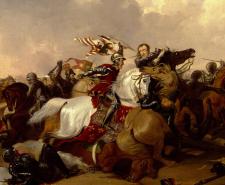
The first battle of the Wars of the Roses broke out in St Albans on 22nd May 1455. Richard overcame an army led by Edmund Beaufort, Duke of Somerset, a favourite of Henry VI.
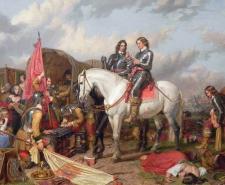
That same year, though, another clash between the Yorkists and the Lancastrians is said to have occurred in the Lancashire backwater of Stubbins. The peculiar story goes that soldiers on both sides ran out of gunfire, leading them to throw puddings at each other instead.
Allegedly, the Yorkists lobbed Yorkshire puddings (what else?), while the Lancastrians chucked black puddings. Amusing though the story is, it seems to be apocryphal. The legend is told as the supposed origin story of the World Black Pudding Championships regularly held in the local area to this day.
3. The Battle of Towton was one of England’s bloodiest ever
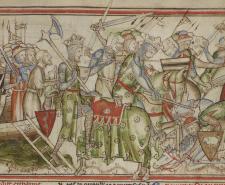
On 29th March 1461, Edward IV’s Yorkist forces faced the Duke of Somerset’s Lancastrian army at the Battle of Towton. It was a hard-fought contest, to say the least, with a nearby field even garnering the sinister moniker of ‘Bloody Meadow’.
There are quite a few gruesome facts about the War of the Roses. As for how many soldiers were slain at Towton, estimates vary. The most startling suggests that as many as 28,000 men could have fallen that fateful day. The battle is consequently reputed as the bloodiest ever to have taken place on English soil.

4. The Battle of Barnet was swayed by friendly fire
Though dislodged from power in 1461, Henry VI was restored to the throne in 1470. That was at the behest of powerful nobleman ‘Warwick the Kingmaker’, who faced the deposed Edward IV at the Battle of Barnet the following year.
The Earl of Oxford fought on Warwick’s side on 14th April 1471, but was undone by fog. Lancastrian troops faintly saw Oxford’s badge but mistook it for Edward’s. Oxford’s men consequently came under fire from their own allies.
The Yorkists took advantage of the disarray among the Lancastrian ranks, and Edward became king once again. His brother Richard III took the throne in 1483 after declaring the ‘Princes in the Tower’ illegitimate.

5. The ‘Wars of the Roses’ weren’t originally called that
After defeating Richard III in battle, Lancastrian challenger Henry Tudor was crowned as Henry VII but married Elizabeth of York. To represent this union of the previously warring royal houses, Henry created a new ‘Tudor rose’ emblem.
This badge combined the red and white roses, but the red rose had not been widely adopted by the Lancastrians before 1485. The popular belief to the contrary eventually inspired the ‘Wars of the Roses’ name.
This relatively modern moniker was popularised by 19th-century writer Sir Walter Scott. Before then, the decades-long dynastic tussle was commonly referred to as ‘the Cousins’ War’.
Keen to savour even more facts about the War of the Roses? Then subscribe to the Sky HISTORY newsletter. We’ll keep you posted when we line up new shows about the medieval era.


