
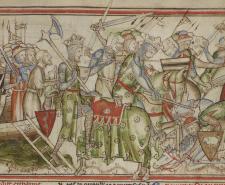
The Battle of Naseby: Parliament’s crushing victory in the English Civil War
In June 1645, the Battle of Naseby turned the tide of the English Civil War – but how? The Sky HISTORY series Britain’s Lost Battlefields finds out.
Image: Oliver Cromwell at the Battle of Naseby by Charles Landseer | Public Domain
England’s monarchy today is very different to that of just four centuries ago. In 1642, long-festering disgruntlement about King Charles I’s autocratic policies led his own Parliament to take up arms against him.
The ensuing English Civil War saw Royalists and Parliamentarians locked against each other in military conflicts for much of the 1640s. Some of these battles on English soil – like those of Edgehill and Marston Moor – are now among the best-known in history.
However, it was another, the Battle of Naseby, that shifted the balance dramatically in Parliament’s favour in 1644. It even gets its own episode in the Sky HISTORY series Britain’s Lost Battlefields – but what made this clash one of the war’s most decisive?
The state of play in early 1645
In early 1645, optimism was running high among the Royalists (or ‘Cavaliers’, as they were nicknamed). Though the preceding few years had seen both sides score impressive victories, the Cavaliers now appeared to be in the ascendancy.
In the autumn of 1644, the ‘Roundheads’ (the nickname for the Parliamentarians) had struggled at the Battle of Lostwithiel and the Second Battle of Newbury. However, Roundhead general Oliver Cromwell – now there’s a name you might recognise – was convinced he knew what was letting his side down.
The New Model Army is born
At the time, Parliamentarian forces were disjointed, consisting of various militia each attached to a specific county area. Cromwell decided that these disparate forces should be merged into one unified, organised fighting force, the New Model Army.
Cromwell also reckoned that the Roundheads needed to recruit soldiers primarily on the basis of their ability rather than background. Parliament duly passed the Self-denying Ordinance, which required MPs holding commissions in the army to relinquish them.
The run-up to the Battle of Naseby
Charles had made Oxford the Royalists’ new ‘capital’ early in the war. However, in May 1645, Roundhead army officer Sir Thomas Fairfax started besieging the city. In a successful attempt to draw Fairfax away from Oxford, the Royalists stormed the Parliamentarian stronghold of Leicester later that month.
In early June, Fairfax marched his troops north to confront the Royalists, who were divided over how to respond. One of the king’s commanders, his nephew Prince Rupert, advocated heading north to swell their army’s ranks.
Conversely, Lord Digby – another senior member of the Cavalier camp – favoured striking the New Model Army sooner rather than later. He considered it still weak enough for the Royalists’ own forces to decisively destroy. Many historians today would not entirely disagree with Digby on this sentiment, and it ultimately swayed the king’s own decision.
How the Battle of Naseby unfolded
The two armies met at around 10am on 14th June 1645, just outside the village of Naseby in Northamptonshire. The resulting battle lasted about three hours, with Fairfax and Cromwell commanding the New Model Army together.
Each army was laid out in the customary mode of the era, with infantry in the middle and cavalry on the flanks. Estimates of how the two armies compared in troop numbers vary. The New Model Army is thought to have had about 14,000 men. Meanwhile, the tally of Cavalier soldiers could have been close to 7,500.
Cromwell made his side’s numerical advantage count, orchestrating repeated cavalry charges. Prince Rupert led an especially daring one of his own deep into Roundhead territory, eventually attempting to attack the enemy’s baggage train. However, defences here held firm, and Rupert was unable to return to the heat of the battle quickly enough to save the exposed Royalist infantry.
The aftermath of the Battle of Naseby
The Roundheads routed the Cavaliers, with the former losing only about 400 men. That’s compared to the latter’s purported losses of 6,000, including a thousand casualties, with the rest captured.
Though Charles himself fled the scene, he never managed to gather another army comparable to that he fielded at the Battle of Naseby. It seemed that the game was up for the Royalists, and Charles finally surrendered to the Scots in May 1646.
After the English Parliament put the king on trial in January 1649, he was found guilty of high treason and sentenced to death. After Charles I’s execution on 30th January, England became a republic. This was the status quo until the late king’s eldest son, Charles II, acceded to the English throne in May 1660.
Fascinated by the Battle of Naseby? You can learn about many other climactic conflicts of the past by subscribing to the Sky HISTORY newsletter.


