
The biggest historical anniversaries in 2026
Many world-shaping events from years gone by will be commemorated with anniversaries in 2026. Here are examples across politics, science, war and culture.
Image: 2026 marks 25 years since the September 11th attacks | Anthony Correia / Shutterstock.com
It might be a New Year, but we’re actually in a pretty nostalgic mood. That’s because quite a few historical anniversaries are coming up in 2026 – and you can bet that many of them will be commemorated in style.
It’s the ideal time to reflect on various headline-grabbing moments, but we at Sky HISTORY couldn’t pack enough of the biggies into just one article. So, here’s our look at this year’s major historical anniversaries.
270 years: Start of the Seven Years’ War (1756)
What was the first truly global war? Despite the name, it wasn’t World War I. Instead, the title goes to the Seven Years’ War. It’s often seen as a conflict primarily between Great Britain and France, though other countries were also drawn in on each side.
Fighting broke out on 17th May 1756 – 270 years ago this year. When the Seven Years’ War ended in 1763, the British were handed victory, but also a dauntingly hefty bill to pay for it.
Westminster consequently sought to balance the books by imposing a new tax on North American subjects. The resulting anger about this ‘taxation without representation’ (the North American colonies were not directly represented in the British Parliament) would trigger another war...
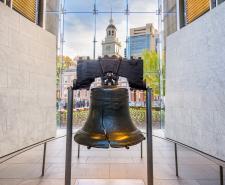
250 years: Signing of the Declaration of Independence (1776)
You might have noticed a fair bit of publicity recently about ‘America250’, the ‘semiquincentennial’ (try saying that ten times fast) of the Declaration of Independence.
This document was written by North American colonials disaffected by new tax levied upon them by the British Crown. Adopted on 4th July 1776, the Declaration of Independence – as its common title suggests – declared the Thirteen Colonies’ independence from Great Britain.
This independence would not be formalised until the 1783 Treaty of Paris brought an end to the American Revolution. Great Britain finally recognised the United States of America (USA) as a sovereign country.
150 years: Alexander Graham Bell patents the telephone (1876)
It’s easy to underestimate how many Scottish inventors have changed the course of history. One good case in point is Alexander Graham Bell, who was born in Edinburgh and would go on to invent the telephone.
Bell was still in his twenties when, on 7th March 1876, he was granted a patent for this groundbreaking new invention. Only three days later, Bell made the first successful telephone call.
In the 150 years since, many other inventors have refined and built upon Bell’s winning formula. Arguably one of the most influential was a Californian businessman called Steve Jobs, who co-founded one of the biggest tech companies in history. More on that later...
110 years: Battle of the Somme (1916)
When it comes to the deadliest battles of World War I, the Somme offensive was especially notorious.
From 1st July to 18th November 1916, the Allies – Britain and France – struggled to penetrate German lines in the Somme area of northeastern France. 2026 marks the 110th anniversary of the battle, which claimed more than a million casualties overall.

100 years: Queen Elizabeth II, Marilyn Monroe and David Attenborough are born (1926)
Two of the 20th century’s most famous female icons were born within weeks of each other. Queen Elizabeth II was born on 21st April 1926, while Hollywood legend Marilyn Monroe followed on 1st June 1926. That makes 2026 the centenary of their births.
The two women even once met in London in 1956, when both were 30 years old. Just six years later, Monroe died from a drug overdose. She was aged just 36, while the Queen would outlive her by more than 65 years, passing away in 2022.
Elsewhere, on 8th May 1926 in West London, broadcaster, biologist and certified national treasure David Attenborough was born. Across a career that has spanned decades, Attenborough has educated the planet on the natural world and the impact of global warming. There’s no doubt there will be widespread celebrations when he reaches his 100th birthday.

100 years: The first liquid-fuelled rocket is launched (1926)
There’s a saying that, while talent hits a target no-one else can hit, genius hits a target no-one else can see. It’s a mantra especially applicable to the case of American inventor Robert H Goddard.
His 1919 treatise A Method of Reaching Extreme Altitudes attracted ridicule for suggesting that a rocket could be effectively propelled into outer space.
Determined to prove his doubters wrong, Goddard successfully launched the first liquid-fuelled rocket. That was on 16th March 1926, making this year the 100th anniversary of that significant breakthrough in rocket science.
In July 1969, as the history-making Apollo 11 mission was about to begin, The New York Times recanted its 1920s criticism of Goddard’s ideas.
60 years: England wins the World Cup (1966)
While on the subject of Queen Elizabeth II, she also played a major ceremonial role at the 1966 FIFA World Cup hosted on English soil. She was present at not only the opening game but also the final, where she handed the trophy to England captain Bobby Moore. His team were now the world champions.
Nonetheless, many of the tournament’s most eye-opening moments actually occurred between those two games. They included a surprisingly successful World Cup run for North Korea. In the 60 years since, the East Asian minnows have qualified for only one other World Cup – the 2010 outing in South Africa.

50 years: Tech giant Apple is founded (1976)
The iPhone has become an instrumental part of millions of people’s lives. However, after Steve Jobs, Steve Wozniak and Ronald Wayne co-founded Apple on 1st April 1976, the company’s initial bread and butter was desktop computers.
In 1984, Apple introduced the Macintosh computer. This product line still exists today as the Mac. Since the Noughties, it’s been joined by the iPhone, iPad and Apple Watch. With Apple now entering its 50th anniversary year, it will be interesting to see what new products the company announces in 2026.
25 years: September 11 attacks (2001)
On 11th September 2001, New York City residents watched in horror as a plane crashed into the World Trade Center’s North Tower. Less than 20 minutes later, another aircraft flew into the complex’s South Tower. Neither skyscraper took long to collapse altogether.
These planes were just two of four hijacked by members of the al-Qaeda terrorist network that morning. Of the other two, one hit the Pentagon, while the other crashed into a field in Virginia after the brave passengers revolted.
Overall, the September 11 attacks directly caused almost 3,000 fatalities. The United States responded by launching the ‘war on terror’. A quarter of a century on, this conflict – waged largely in the Middle East against Islamic terrorists – has never really ended. However, Osama bin Laden, the al-Qaeda leader responsible for orchestrating the shocking events of September 11, was killed by US forces in 2011.

10 years: Britain votes to leave the European Union (2016)
When the European Union (EU) was established in 1993, the United Kingdom was a founding member. By the 2010s, however, anti-EU sentiment was clearly growing among the British population.
The UK Independence Party (UKIP), which ran on a platform of withdrawing the UK from the EU, made major electoral gains. This led UK Prime Minister David Cameron to hold a referendum on Britain’s continued EU membership in June 2016.
In a shock result, the ‘Leave’ vote took about 52% of the vote, compared to roughly 48% for ‘Remain’. The UK officially left the EU in 2020, but recent polling suggests that most Britons now believe ‘Brexit’ was a mistake. The public mood will surely be bittersweet as the referendum’s tenth anniversary nears.
10 years: Music greats David Bowie and Prince pass away (2016)
A decade ago, the music world lost two of its all-time greats - David Bowie and Prince. Both were renowned for their unorthodox, experimental approaches to musical artistry.
Bowie opined in an interview: ‘I think he has the same sartorial indulgences that I have.’ He also acknowledged their similarly prolific songwriting. Between them, the two released literally dozens of albums.
After Bowie’s death from cancer on 10th January 2016, Prince paid his respects by performing one of Bowie’s best-known songs, Heroes. Prince himself died of an accidental fentanyl overdose later that year, on 21st April.
Now you’ve looked back, you can look forward – by subscribing to the Sky HISTORY Newsletter. It’s a great way to get news about our upcoming shows.


