
'They bring us face-to-face with centuries past': Simon Thurley on why we must rescue our British castles
From funding priorities to ten-year restorations, Simon Thurley reveals what it takes for National Lottery funding to save Britain’s castles.
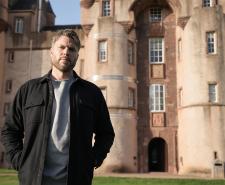
In Great British Castle Rescue, Rick Edwards visits some of the UK's most spectacular but engandered castles. He meets the heritage experts, engineers and stonemasons who are racing to save these buildings, with the help of funding from the National Lottery. Sky HISTORY spoke with Simon Thurley, historian, heritage expert and Chair of the National Lottery Heritage Fund about how the organisation works to restore these castles.
Great British Castle Rescue starts Monday, 9 March at 9pm on Sky HISTORY.
1. What counts as a castle and why are they important to the UK’s heritage?
Think of a British castle and an image quickly comes to mind: imposing stone walls hundreds of years old, perhaps on a hill-top. Maybe its interior has been remodelled as its use changed, it might remain in private hands or often today it is in ruins. Certainly, though, it will have presence in the landscape, projecting the power and ambition of its builders across the land it surveys.
Castles, with churches and cathedrals, are amongst the oldest buildings in the UK. They bring us face-to-face with the people and events of centuries past. Castles let us imagine scenes of everyday life – where people cooked, slept, entertained and sometimes fought for their lives. Standing at Warwick Castle’s gatehouse, for instance, you can feel the weight of history – victorious knights, chained prisoners, bejewelled monarchs and humble serving men and women and now, of course, hordes of happy visitors.
Castles emerged from the time when our borders were contested and conflict a tangible threat, when regional power was in the hands of powerful families whose seats doubled as a fortified military base and a marker of authority. But Britain is unusual in the way that its castles morphed from military installations to stately homes in the sixteenth century. As an island, with stable borders and domestic peace, fortification became unnecessary, although many people wanted to own a house with battlements and towers. Soon castles became a stylistic choice not a military necessity. Meanwhile across Europe, people’s residences and whole towns and cities remained stoutly fortified and defended against invaders and insurgents.
2. The National Lottery has invested heavily in protecting and restoring castles across the UK. Why is it so important to keep these places alive today?
The National Lottery Heritage Fund is the proud distributor of funds raised by National Lottery players to projects that connect people to the UK’s heritage. Since 1994 we’ve invested around £200million in castles, from multi-million pound restorations of masonry and moats down to community archaeology digs and improving information for visitors. Despite their original purpose to keep people out, somehow castles are amongst the most welcoming and accessible heritage sites in the country popular with professors and toddlers alike.
Castles are significant for their age, architectural grandeur and archaeological secrets. But just as important, they are an integral part of their local landscapes. Anyone familiar with the east coast railway main line will know what I mean, with its unforgettable views of Durham Castle, Lindisfarne Castle, and the ruins of the former castles at Berwick and Newcastle.
They are also a key part of the UK's attraction for international and domestic tourists – indeed the top reason that international travellers visit the UK is for its historical and cultural appeal. Heavyweights like Edinburgh Castle, Dover Castle, the Tower of London and Windsor Castle draw millions of visitors each year. Our grants to care for historic castles is about more than preserving history. Visitor appeal unlocks local prosperity, and a flow of investment into the nation’s heritage, including craft skills industries such as heritage stonemasonry and carpentry.

Image: Simon Thurley has been Chair of the National Lottery Heritage Fund since 2021
3. What are your teams looking out for when considering an application for funding?
A solid plan for securing heritage for the long-term, for public benefit. From 30 years of grant giving The National Lottery Heritage Fund knows the significant challenges of caring for a historic castle and provides specialised guidance and local advice to assist those considering approaching us for funding. But a clear vision accompanied by a realistic plan with the right expertise are the core fundamentals of all good projects we fund.
4. A castle restoration is not a quick process and I'm sure no two castle restorations are the same, but how long might a full restoration take?
Castles are in constant need of repair, like any historic building or monument. Many castles we see in Great British Castle Rescue are facing troubles caused by previous attempts to stabilise walls, where good intentions had unforeseen consequences. Developing a thorough understanding of the site and taking the care and attention to get a restoration right is part of the reason they can take so long.
Castle restorations have to consider not just how to restore the building, but ensure the building is fit for modern visitors and can earn its keep for future phases of conservation. In cases where top-to-bottom restorations of major castles take place – like most recently at Norwich Castle – it’s not uncommon for them to take ten years from planning to the grand reopening. This is a sign of how large in scale these projects are, encompassing not just protecting historic fabric, but also enabling they’re accessible and useful commercial spaces fit for modern visitors.
5. Of all the castles that have been restored or even saved, is there one that you are particularly proud of and why?
I suppose I'm particularly proud of what National Lottery money has supported at Norwich Castle. Being a proud Norfolkman it is our county castle and it's wonderful to see it brought back to life. It’s like stepping back into the 12th century, with interiors from the interior well to hanging tapestries meticulously researched and recreated to our best guess at how it originally looked.
What Norwich Castle has achieved is special to me because it’s a continuation of the approach to restoring Norman castles that I was part of during English Heritage’s work at Dover Castle. The lessons learned at Dover have been passed on for our friends and partners at Norwich to learn – and they’ve done a tremendous job of it.
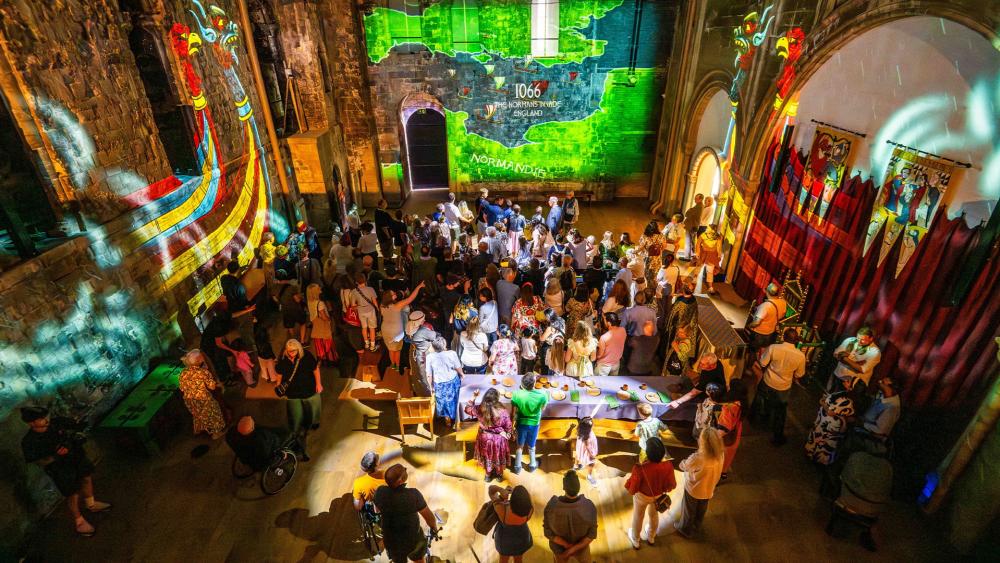
Image: Visitors experience the immersive projections which tell the story of the medieval building in the Great Hall of Norwich Castle Keep | Norfolk Museums Service
6. What’s the most surprising or memorable story, discovery or object you’ve come across in a castle you’ve helped fund?
Oxford Castle is not as well-known as it should be. In the middle of a city full of amazing buildings the castle is the oldest and amongst the most interesting monuments in Oxford. Its Anglo Saxon tower is a great rarity, but the most intriguing bit is being able to stay the night there. I was lucky enough to spend a night in the castle hotel with my wife last year. The castle was turned into Oxford prison and contains a complete Victorian jail, cells and all. The hotel bedrooms were in the prison cells. Being locked into a cell in a castle overnight was a memorable, and surprisingly comfortable experience.
7. How important is sustainability in historic castle conservation and how do you do it well?
Sustainability has many aspects – it isn’t just solar panels and energy efficiency, it’s resilience within our changing world. And core to that is getting the basics right of a windproof, watertight building. Good conservation projects will address risks before they become hazardous and plan proactively for the future. They might incorporate sympathetic conservation and design choices like reusing timber and repointing using materials that help the building breathe.
Climate adaptation is a core tenet of environmental sustainability, where those caring for a historic castle consider how to prevent damage to historic fabric posed by our changing world. Sites might need to consider challenges from flooding, droughts, extreme high winds, coastal erosion and sea level rises, changes in seasonal temperature such as managing severe overheating, and invasive non-native pests and diseases. At Norwich Castle for example, part of the recent renovations included adaptations to drainage systems on the roof to accommodate heavier rainfall.
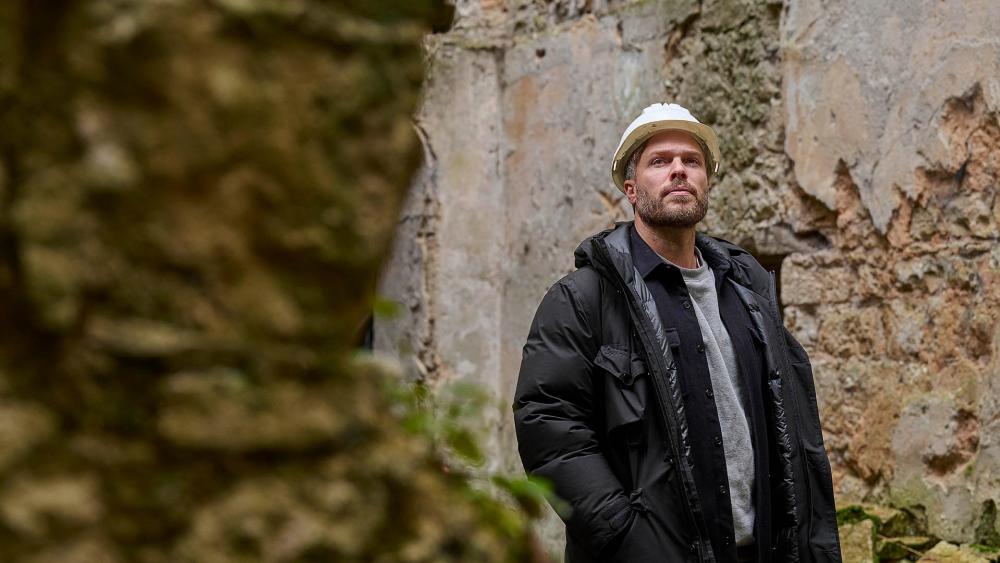
Image: In Great British Castle Rescue, Rick Edwards visits some of the buildings whose restorations are being backed by National Lottery funding | Great British Castle Rescue
8. What do you see as the biggest challenges or opportunities for castle conservation in the next 20–30 years?
Heritage means something different for each generation and reflects the preoccupations of our own time as much as the stories of the UK’s past. I’m excited about how we connect people to the stories and care of the castles they visit, live near, and work or volunteer at. We must ensure that historic castles have stewards in the next generation to see them properly cared for and loved in the future.
Traditional building skills, like many heritage crafts, face double threats of economic viability and a lack of skill transfer to young people. This is something that funders of heritage are keenly aware of, and excellent work is done by the likes of Historic England and the Society for the Protection of Ancient Buildings (SPAB), to name a few, to pass on rare craft skills. This is something that needs constant and continuous focus and funding.
9. Of all the historical figures in history, which three would be your ultimate dinner guests and why?
Charles II, to hear about his adventures in exile. Peter Paul Rubens, genius painter, diplomat, scholar and courtier. And the four-times married Elizabethan socialite Bess of Hardwick, who met every major figure of her day and demonstrated that Tudor women were often as powerful as their male counterparts.
Great British Castle Rescue starts Monday, 9 March at 9pm on Sky HISTORY.


