
5 biggest castles in the world
As Great British Castle Rescue lands on Sky HISTORY, we ask: What are the world’s biggest castles? When were they built, and how have they fared since?
Image: Malbork Castle in Poland is known as one of the biggest castles in the world | Shutterstock.com
Castles were built en masse during the Middle Ages, primarily to fortify lands against the threat of invasion. Many castles are no longer used for military purposes but continue to be preserved as tourist attractions.
Some castles in the UK have sadly deteriorated, but the new Sky HISTORY series Great British Castle Rescue reveals attempts to save them. Other castles were expanded so significantly during their original period of occupation that they remain among the largest still standing.
It’s not entirely straightforward to rank castles according to their size. Perhaps the simplest way is to measure by land area – and stick to structures still fully (or almost fully) intact. With all that in mind, here are what we at Sky HISTORY deem – from smallest to largest – the world’s biggest castles in square metres…
5. Hohensalzburg Fortress, Austria (54,523 sq m)
Salzburg is famous as the birthplace of Classical composer Wolfgang Amadeus Mozart. If you do visit to check out the Mozart-related tourist attractions, though, consider also exploring the city’s Hohensalzburg Fortress.
This castle first started taking shape in the 11th century and can be seen from far and wide, as it straddles the Festungsberg mountain. The building’s early construction took place under the watchful eyes of Salzburg archbishops.
Hohensalzburg Fortress has had an eventful history since. It was seized by French general Jean Victor Marie Moreau’s troops in the Napoleonic era and held Italian prisoners of war during World War I. Visitors to the building today can see its 16th-century additions and hear music from the ‘Salzburger Stier’, the oldest horn organ still in regular use.

4. Windsor Castle, England (54,835 sq m)
The year 1066 is one of the most famous in English history, imprinted in the public’s mind due to the Norman conquest. However, in its aftermath, the newly crowned king William the Conqueror still had a nation of unruly Anglo-Saxons to subdue.
One measure he took was to build Windsor Castle, which, over the next few centuries, proved effective at keeping besieging troops at bay.
Of course, since the end of the English Civil War in the 1640s, Windsor Castle hasn’t had to serve much purpose as a military fortress. These days, it’s predominantly seen as a royal residence – an especially enviable one, too.
According to rumour, Adolf Hitler even intended to set up home in Windsor Castle in the event that Nazi Germany conquered Britain.

3. Prague Castle, Czech Republic (66,761 sq m)
Construction on Prague Castle started as long ago as the 9th century. The current structure was repeatedly expanded over the centuries, and is now much larger than its early builders would have envisioned.
Hence, it incorporates a wide range of architectural styles – from Romanesque to Gothic. Prague Castle has been home to successive monarchs. Today, it is essentially the White House of the Czech Republic, as it serves as the president’s official residence.
At the same time, Prague Castle is open to the public. Its popularity as a tourist destination is doubtless fuelled by its imposing design and enthralling history. The building even continues to house the Bohemian crown jewels.
2. Mehrangarh Fort, India (81,227 sq m)
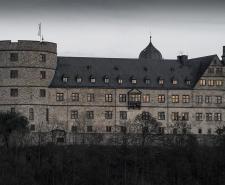
When you’re in Jodhpur, Mehrangarh Fort is pretty easy to spot. It towers about 122m above the city, having originally been built in the 15th century by Rajput clan chief Rao Joda.
The fort you see today isn’t entirely his work, however – most of it actually dates from the 17th century. The Jai Pol gate was built even later to commemorate a 19th-century military victory.
Mehrangarh Fort left an especially big impression on the Indian-born English writer Rudyard Kipling. The Jungle Book’s author hailed the fort as ‘a palace that might have been built by Titans and colored by the morning son’.

1. Malbork Castle, Poland (143,591 sq m)
One of the biggest myths about medieval warfare is that European castles were always made of stone. However, Maldork Castle was actually built from bricks around the 14th century.
This Gothic castle complex was assembled by the German religious order known as the Teutonic Knights. Lying alongside northern Poland’s River Nogat, this castle is the world’s largest when measured by land area.
It was originally smaller, but later grew as more and more of the Knights adopted it as their base. From here, they were able to more easily fend off their Polish adversaries. The Teutonic Order abandoned the site in the late 15th century.
To keep yourself informed about what’s going on in scholarly circles, subscribe to the Sky HISTORY newsletter.


