
Finding Arbella: A historian follows a forgotten Tudor-Stuart heir
Lynsey Shaw retraces Arbella Stuart's 17th-century journey from London to the Midlands, revealing why it is a story that deserves its place in history.
Lynsey Shaw is a writer, creative producer and performer who has a passion for finding fresh and entertaining ways to bring history to life, especially the stories of women who have been overlooked. Her project, 50 Days of Arbella, retraces the Tudor-Stuart heir’s 1609 royal progress through the Midlands, combining archival research, creative practice and unexpected personal discoveries.
In this guest article for Sky HISTORY, Lynsey shares the story behind this journey, how she was connected to Arbella all her life without knowing and why this is a part of history that deserves to be remembered.
417 years later
It’s Saturday, 22 August 2026, and I’m standing outside the Banqueting House at Whitehall, where Charles I spent his last moments before the executioner’s block. It’s a glorious sunny day after a long dry summer, and I wonder what the weather was like in 1609. The hall is all that remains of the sprawling Whitehall Palace. It was from here, 417 years ago to the day, that Arbella Stuart set out for the Midlands. I am following her on a 50-day journey that grew out of my PhD research. I have the sources, the route and a rough plan with plenty of gaps.
I thought I was finding Arbella. What I hadn’t expected was how often the journey would lead me back to my own story.
In August 1609, Arbella Stuart, first cousin to King James VI and I, great-great-granddaughter of Henry VII, niece by marriage to Mary, Queen of Scots, and granddaughter of Margaret Douglas, Countess of Lennox, and Bess of Hardwick, Countess of Shrewsbury, left London on a progress through England. Once seriously considered as a successor to Elizabeth I, Arbella remained one of the foremost blood claimants to the English throne under James I, and a woman whose dynastic importance ensured she was closely watched. She travelled with a household, horses, servants and baggage, all the infrastructure needed to move a woman of her status around Jacobean England. She had done this before, but never so soon after Bess’s death, nor on the brink of the decision that would change everything.
Those who have heard of Arbella Stuart, and many have not, know her for her ending: confinement, failed escape and death in 1615. Mention her name and you usually get a blank stare or a “but her story is so sad”. I am more interested in an earlier version.
What happens if we stop looking at Arbella Stuart from the Tower backwards and instead meet the woman who was moving through the world in 1609?
Behind my garden
But the idea took shape a year before I set out, and much closer to home. Sitting in my family home in Leicestershire, I read one line in David Durant’s Arbella biography that changed my research trajectory. ‘They spent the night of September 28 at Quorndon House… with the Farnhams who had been at Court in the old days of Elizabeth.’
The sources record a payment to Mr Farnham’s servants on 29 September. Durant uses the name of the later house on the site, but during her 1609 progress, she had stayed at Over Hall, the ancestral seat of the Farnhams, squires of Quorn, my home village. Part of her story had been sat, quite literally, behind my garden all along.
For as long as I could remember, I had been looking out of my bedroom window at a piece of national history without knowing it. I study cultural memory, the mechanics of collective remembering and forgetting, and here was a forgetting on my own doorstep. What else had been lost locally, and what might local historians help me find if I physically followed her?
On the road
So, I set out to follow Arbella north from London through Hertfordshire, Bedfordshire, Northamptonshire and Leicestershire, on into Nottinghamshire, Yorkshire and Derbyshire, and south again through Leicestershire, past the view from my bedroom window.
Four centuries on, little of her passage is obvious. Roads have moved, houses have vanished, and the places she stayed are now fields, farms or private homes. But the surviving records leave a trail, turning a line on a map into something lived, day by day, by a woman and the people who travelled with her.
I followed it. I drove it. Walked it. Filmed it. I stood in fields where great manor houses had once been. I met the people who know these landscapes best: local historians, heritage custodians and residents who each hold a piece of Arbella’s story.
On one of my first online calls, the opening question was: 'Now, who is Arbella Stuart?' As a cultural memory researcher, it fuelled my mission.
In 1609, Arbella was welcomed in these landscapes: bells rang, locals gathered, sermons were read, food and lodgings were prepared, and alms were given to the poor. Four centuries later, a custodian of a building where she had stayed did not know her name. Now that person keeps a printout of her portrait on hand to show visitors. After one conversation, Arbella is back in the landscape and being remembered again.
The landscape was teaching me too. It was tiring, and I wasn’t on horseback or in a bone-shaking seventeenth-century carriage. I climbed steep hills where I imagined the entourage, at the end of a twenty-mile day, pushing twenty horses one last time towards lodgings in St Albans. The flatter terrain of Northamptonshire gave way to the heights and valleys of the Peak District, and through Sheffield’s housing estates, the ups and downs were plain. The sources echoed the terrain: broken springs, make-do repairs, servants from the last and next houses to guide them through, horses and servants in need of care and carriages needing mending.
A source can tell you that something happened. The landscape makes you ask how. At Cotes, near Loughborough, the records describe a vast manor house by the River Soar. Standing on the spot, I found rain-soaked, cowpat-covered farmland, brick rooms peeking from the earth and archways swallowed by brambles. Places like Cotes sent me back to the archives, to reconstruct vanished houses and trace family connections. With each stop, Arbella’s day-to-day life was revealed in tangible glimpses: cake and ale at a Nottingham roadside inn; material for a red petticoat bought at Glapwell while the carriage was repaired; a local teacher reading passages; musicians tipped; and Arbella, even on the move, hunting a stag.
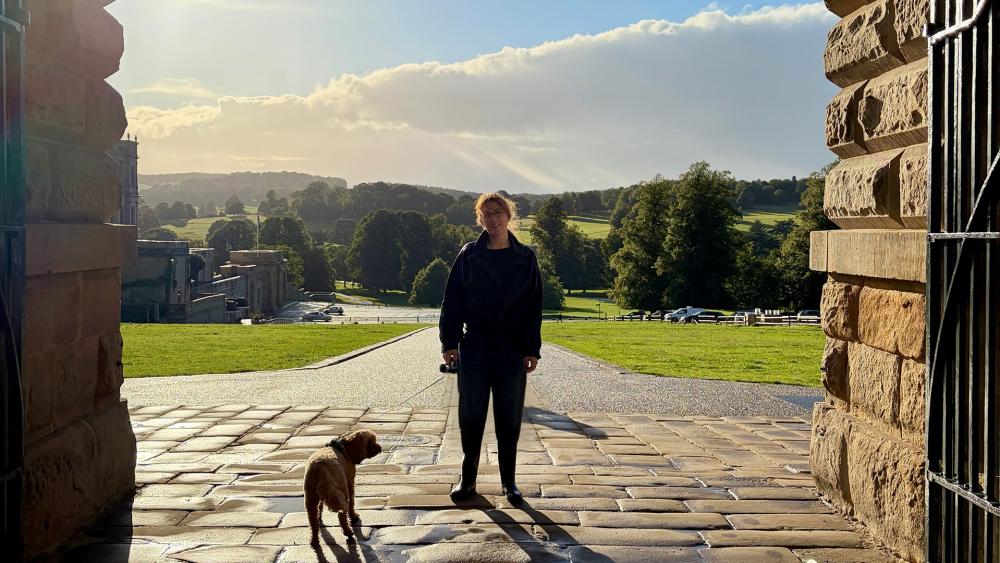
Edensor
Arbella was born into the Cavendish world to Elizabeth Cavendish, Bess’s daughter, and spent much of her childhood in her grandmother’s Derbyshire houses. I went to Chatsworth and Edensor, the estate village in its park, for her family’s story. I did not expect to find my own.
Three strands of my family lie in the graveyard of St Peter’s Church, having served the Chatsworth estate for generations. My sixth great-grandad, James Bampton, a master tailor and draper in the 1700s, may well have dressed the dukes of Devonshire. The Bland and Loton husbandmen became one strand when their children married. My fourth great-grandad, Robert Bland, was a master mason who worked in the Chatsworth building yard.
So far, my line reaches back to my tenth great-grandfather, William Loton. Born in 1619, four years after Arbella’s death, he brought his first child to the font at Edensor in 1645. His parents may well have been living in the parish while she was alive. I have no evidence yet that my ancestors knew her. But within a decade of her progress, our two families shared the same corner of Derbyshire, and they still share the same churchyard: the maternal ancestors of my Grandad Jack - an illegitimate boy from Swadlincote who never knew his dad - resting beside dukes and duchesses, a Mitford and a Kennedy.
At Over Hall, Arbella’s story sat behind my garden. At Edensor, I followed her into her family’s landscape and found my own already there. Our stories entwined once more.
A year and a half
Four-fifths of the way along, something else dawned. Bess died in February 1608. Arbella set out eighteen months later. My mum died in May 2025. I set out fifteen months later. Bess, Arbella’s grandmother, had also raised her after she was orphaned and, for all their complications, was the matriarch at the centre of her world. Mine was my brilliant north-star mother, who steered me towards Bess of Hardwick in my thirties, insisting we visit Hardwick Hall so I would know this fascinating Elizabethan pioneer. Without her, I might never have found Arbella at all.
Travelling at a similar distance from my own loss made me newly conscious of something chronology can flatten: Bess’s death was recent. Her houses, objects, people and landscapes still surrounded Arbella. My own grief taught me what the months after somebody dies can feel like. I began to wonder whether she, too, was taking stock: testing the ground, weighing her options, looking after her health, visiting family and considering where she wanted to spend the next part of her life. As am I.
Alive in 1609
So, what did I find? An Arbella much harder to reconcile with the passive figure flattened when her life is read backwards from tragedy. This Arbella was watched, but she was also active, performing, choosing; received, served, dressed and entertained, moving through powerful family networks, at times costly, at others reassuringly ordinary. And I found that simply talking about her was enough to re-establish her presence in the land.
Above all, I found her alive. Within a year she would secretly marry William Seymour; within two she would be a prisoner attempting to flee England. In August 1609, none of that had happened yet. For these 50 days, 1609 remained 1609.
She had always been there
In the end, Arbella’s road brought me back to Quorn, past the site of Over Hall and the house that my mum left to us. In 1609, Arbella passed this way back to London and a choice she was yet to make. Two years later, she was sent north under guard, but the journey stalled at East Barnet. Rather than continue to Durham, she escaped. She would never see these familiar landscapes again.
I haven’t finished following her. There are archives to return to, family histories to find and stories still waiting in other people’s houses, but my PhD, writing and music have already grown beyond anything I imagined when I left Whitehall. I set out looking for a woman who had disappeared. I found that Arbella had always been there: in the fields, the ruins, the hills, the view from my bedroom window. She was simply waiting to be remembered.


