
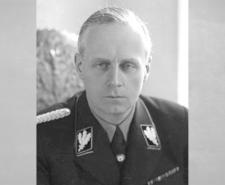
Erik Jan Hanussen: Hitler’s personal prophet
Erik Jan Hanussen was one of Europe's most celebrated clairvoyants – and one of Hitler's most unlikely confidants. Here's the story of their strange alliance.
Image: Erik Jan Hanussen conducting a seance | Public Domain

In 1919, the Treaty of Versailles was signed, bringing World War I to an end. The treaty pinned all the blame for the war on Germany and extracted tough reparations from the new ‘Weimar Republic’ as a result.
It all left the former German Empire in the financial doldrums. The fraught economic situation faced by Germans in the 1920s is painted vividly in Sky HISTORY’s World War II with Tom Hanks.
What were these embattled German citizens able to look forward to, if anything? Surely only a soothsayer would know? One man happy to step into that void was Erik Jan Hanussen, who even caught the eye of Adolf Hitler. How did the two men get on? We at Sky HISTORY went looking for answers.
Erik Jan Hanussen’s early life
Erik Jan Hanussen didn’t always go by that name. He was long known as Hermann Steinschneider, having been born in Vienna on 2nd June 1889. His parents Siegfried and Juli were touring performers, and often took the young Hermann with them on their travels.
In his autobiography Meine Lebenslinie (‘My Lifeline’), Hanussen claimed that his psychic powers emerged at an early age. However, the book was not published until 1930, around the height of Hanussen’s global fame as a clairvoyant. By then, Hanussen was known to be boastful, and many elements of the autobiographical narrative are of dubious veracity.
These include a story that, shortly after his mother’s death at the age of 30, Hermann helped the police to catch a thief called Grasel. Independent research suggests that this ‘Grasel’ was actually hanged decades earlier, well before Hermann was even born. Another doubtful tale in Meine Lebenslinie concerns the 14-year-old Hermann seducing a 45-year-old woman.
Erik Jan Hanussen’s rise to fame
While serving in the army during World War I, Hermann amazed fellow troops by miraculously picking up on intimate details of their personal lives. Was he actually reading minds? Unbeknownst to the soldiers, Hermann had opened and read letters addressed to them.
So, no, his supposed psychic abilities might not necessarily have been the real deal. As a young man, he had even written booklets denouncing telepathy and mind-reading as fraudulent activities. Apparently, though, he soon learned how to convincingly fake them himself. Before the war was out, Hermann fled the army and adopted what would become his stage name, Erik Jan Hanussen.
The self-christened Hanussen was soon wowing crowds across Europe, pouring his newfound wealth into drug-fuelled parties, including on his luxury yacht. It is unclear when he first met Hitler, but psychologist Dr Walter C Langer later claimed it to have happened by the 1920s. In a report for the United States’ Office of Strategic Services in 1943, Langer said Hanussen had established himself as ‘a practising astrologer and fortune-teller’.
Erik Jan Hanussen’s relationship with Hitler
Hanussen buttered up Adolf Hitler after the latter became leader of the Nazi Party in 1921. Hanussen publicly claimed that Hitler’s rise to power was inevitable. Behind the scenes, Hanussen also reportedly helped Hitler to hone his oratory skills.
Hanussen’s already glittering reputation for accurate predictions only grew after Hitler took control of the German government in the early 1930s. However, by cultivating a close bond with the Führer, Hanussen was playing with fire, as he had not been entirely open about his Jewish faith.

Even when pressed on the matter, Hanussen claimed to have only been adopted by Jews. Unfortunately, this was at least one attempt at subterfuge that Hanussen wouldn’t manage to get away with for very long. That’s because Hanussen was about to make his most startling, notorious prediction – that a ‘great house’ would soon be on fire. In February 1933, Berlin’s Reichstag building was in flames.
Erik Jan Hanussen’s shocking demise
Hanussen had become friendly with Nazi officials, even bankrolling many of their decadent personal pursuits, such as gambling. However, weeks after the Reichstag fire, Hanussen was found dead on the outskirts of Berlin, his corpse peppered with gunshot wounds. Who had wanted to assassinate him? There’s no way to be certain, but one particular theory has come to the fore…
The Nazis claimed that communists had set the Reichstag ablaze. Conversely, the Nazis have long been suspected by some historians to have done so themselves, blaming the communists to justify cracking down on civil liberties. Might Hanussen’s prediction have convinced the Nazis that he had foreknowledge of their devious plot but couldn’t be trusted with their secrets?
For more on the extraordinary and overlooked figures of the interwar period, sign up to the Sky HISTORY newsletter. Every week, you'll receive the latest articles, episodes and more delivered straight to your inbox.


