

The Thirty Years’ War: How a revolt in Prague engulfed Europe
The Thirty Years’ War devastated central Europe. Here’s how a revolt in Prague drew in the Danes, Swedes and French.
Image: A 19th-century painting depicting the Third Defenestration of Prague | Public Domain
What was the Holy Roman Empire (HRE)? The 18th-century philosopher Voltaire once famously insisted that it was ‘in no way holy, nor Roman, nor an empire’. Whatever it was, it certainly wasn’t a tightly centralised, unified state – even by the standards of its own time. Rather, it was a ragtag bunch of only loosely affiliated kingdoms, principalities and other territories.
The constituent parts of the HRE could vary significantly, not just in political structure but also religious practices. Since the Peace of Augsburg in 1555, rulers within the HRE were entitled to adopt either Lutheranism or Roman Catholicism as their state’s official religion.
However, as the HRE’s internal religious divisions splintered even further, civil war would eventually erupt in 1618. Other European powers, including France, Denmark and Sweden, would also be dragged into the conflict, keeping it burning for three decades. Sky HISTORY looks at how a revolt in Prague grew into a war that engulfed much of Europe.
What caused the Thirty Years’ War?
In 1617, Archduke Ferdinand of Styria was elected as king of Bohemia. However, many of this HRE kingdom’s nobles were staunchly Protestant. So, when the new Roman Catholic regime ordered a halt to the construction of Protestant chapels, panic set in. Was this just the start of an assault against Bohemian Protestants’ religious rights?
Tensions bubbled over so severely that, on 23rd May 1618, three imperial officials were thrown from a window of Prague Castle. This now-iconic incident became known as the ‘Defenestration of Prague’, with both men miraculously surviving the drop of about 16 metres. Rebels went as far as deposing Ferdinand from the Bohemian throne in 1619 and replacing him with Frederick V of the Palatinate.
Frederick was widely seen (even by Protestant powers outside the HRE) as a usurper. This left him without enough support to keep hold of the Bohemian throne, especially as its former occupant, Ferdinand, was now Holy Roman Emperor. The imperial commander Johann Tserclaes, Count of Tilly defeated Frederick’s forces at the Battle of White Mountain in 1620. Frederick subsequently abandoned his Bohemian kingdom, but the resurgence of imperial authority inflamed tensions elsewhere.
How fighting spread within the Holy Roman Empire
The imperial army’s successes enabled Ferdinand II to extend Catholic influence further north within the empire. However, Christian IV of Denmark wasn’t comfortable with the prospect of Catholic hegemony so close to his own doorstep. Christian sought to help the empire’s northern Protestant states turn back this tide, but withdrew in 1629 after a string of military defeats.
In the early 1630s, it was the Swedes’ turn to champion the German Protestants’ cause – and, compared to the Danes, they had much better luck. The Swedish king Gustavus Adolphus proved himself a talismanic commander, even humbling Tilly at the Battle of Breitenfeld in 1631. The French, hoping to rein in the power of the Holy Roman Empire’s Habsburg monarchy, joined the war directly on the side of the Swedes in 1935.
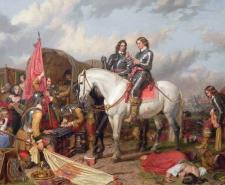
By the 1640s, many powers still fighting in the Thirty Years’ War were exhausted and clamouring for peace. In 1648, the Peace of Westphalia was signed, granting territorial concessions to France and Sweden. Sweden secured territory on the Baltic coast, cementing its position as a leading power in the region. Within the Holy Roman Empire itself, religious freedoms originally bestowed in 1555 were reaffirmed. Calvinism, another Protestant sect, was added to the empire’s list of legally recognised religions.
The legacy of the Thirty Years’ War
After decades of internal strife, the Holy Roman Empire was finally at peace again. However, the terms struck at Westphalia were tough on the empire, leaving it even more politically fractured than before. Its days as a major European power were now firmly in the dust.
Though the HRE limped on for about another century and a half, the Napoleonic Wars would be the straw to break the imperial camel’s back. Francis II would be the last Holy Roman Emperor. After suffering an especially humiliating military defeat to Emperor of the French Napoleon Bonaparte, Francis called it a day for the HRE. It was dissolved in 1806.

The Thirty Years’ War is thought to have given rise to the concept of ‘nation-states’. It also ravaged both the men who fought it and the innocent civilians caught up in it. The Thirty Years’ War is estimated to have potentially claimed as many as eight million lives, a death toll swelled by combat, famine and disease. It would be the 20th century before such devastation struck German lands again.
For more on the wars that shaped Europe, sign up to the Sky HISTORY newsletter. Every week, you’ll receive the latest articles, episodes and more delivered straight to your inbox.


