
Is 'The Choral' based on a true story?
The Alan Bennett-scripted drama 'The Choral' has attracted praise, but how faithfully does the film capture intricacies of British life during World War I?
Image: Ralph Fiennes portrays choral master Dr Henry Guthrie | Sony Pictures Classics
Those who lived through World War I remembered it as the conflict that changed everything. When Britain declared war on Germany in 1914, ordinary Brits were initially enthusiastic. ‘Kitchener’s Army’ would be essentially getting a free holiday, and it would all be ‘over by Christmas’…surely?
In reality, as the war dragged on, word got out about the true horrors awaiting those sent to the front line. Young men who once would have jumped to join the army soon got cold feet. In 1916, Herbert Henry Asquith’s Liberal government had to introduce conscription to swell the ranks of British soldiers fighting ‘the Hun’ overseas.
Director Nicholas Hytner’s latest film collaboration with playwright and screenwriter Alan Bennett, The Choral, is set in a Yorkshire town in 1916. It follows a local choral society struggling to make up the numbers after losing many of its members – even its choral master – to military service. It leaves us at Sky HISTORY wondering how well The Choral captures the tension that actually took hold in Blighty as the war raged.
What is the plot of The Choral?
The choral society in The Choral resorts to desperate measures as its numbers deplete. The society is located in the fictional town of Ramsden, a name apparently inspired by Huddersfield, a Yorkshire settlement originally built on the Ramsden Estate.
During World War I, 23 male members of the Huddersfield Choral Society left to enlist. Two of these men, Lewis Walker and Frank Rushfirth, never returned home. Bennett told the BBC that he was familiar with the Huddersfield Choral Society going through ‘all sorts of dramatic upsets’.
In The Choral, Dr Henry Guthrie (played by Ralph Fiennes) takes over as the new choral master, but must decide which operatic pieces the choir should sing. Many of the usually obvious candidates were written by German composers, ruling them out of the running.
Guthrie eventually selects the British composer Edward Elgar’s The Dream of Gerontius. Here, we see another parallel to Huddersfield, as its choral society was responsible for the first recording of this piece.
Does The Choral get the historical context right?
The histories of Britain and Germany were closely intertwined for centuries before the onset of the ‘Great War’. Britain’s Hanoverian royal dynasty hailed from a German state, while multiple British royals married German spouses.
However, during the war, even pre-existing connections to Germany suddenly looked distasteful. Hence, George V jettisoned his royal house’s German moniker, ‘Saxe-Coburg and Gotha’', in favour of the quintessentially English-sounding ‘Windsor’.

How had Britain grown so close to Germany in the first place? One big reason was their shared Protestant heritage. This religious aspect of British life still lingered in the war years. In The Choral, Elgar’s The Dream of Gerontius is chosen only reluctantly due to its inclusion of purgatory, a distinctly Catholic principle.
Are any of The Choral’s characters based on real people?
The only real-life historical figure to appear in The Choral is Elgar himself, played in fine style by legendary thespian Simon Russell Beale. Still, it’s not hard to see how other characters have at least been inspired by actual people from the war era.
In the film, Guthrie decides to recruit teenagers to the choir to replace those singers who have left to fight in the war. However, as these newcomers will be eligible for the draft upon reaching the age of 18, they are understandably anxious about their futures.
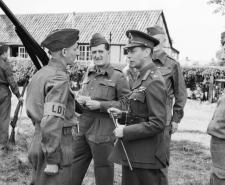
In one scene, a woman presents a boy with a white feather and demands to know why he hasn’t enlisted. He replies that he is still underage, but this kind of encounter was actually pretty common during the war. This part of the script is a nod to the ‘White Feather Campaign’, where women attempted to shame draft dodgers by giving them white feathers.
The campaigners saw themselves as doing their bit for the war effort. Often, though, even men exempt from military service - such as the injured, disabled and, yes, the overly young - would be undeservedly handed these stigmatising feathers.
Is The Choral worth watching?
Nicholas Hytner and Alan Bennett are no strangers to historical drama, the director-screenwriter pair having previously worked together on The Madness of King George.
Like that 1994 film, The Choral does have a few moments of dubious historical authenticity. All in all, though, it is rich in period-relevant detail, providing fascinating insights into the British experience of World War I.
What new, history-themed shows and documentaries do we have in the pipeline? Find out by subscribing to the Sky HISTORY newsletter.


