

Thomas Mann: How accurate is the film ‘Fatherland’?
How accurate is the Thomas Mann film Fatherland? Here’s what Pawlikowski’s drama gets right, and what it changes, about Mann’s 1949 return to Germany.
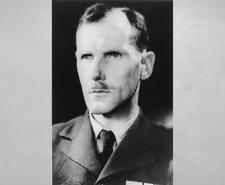
Image: Thomas Mann | Public Domain / Background: Shutterstock.com
With Nazi Germany’s unconditional surrender in May 1945, the European theatre of World War II finally came to an end. However, memories of the Nazi era would cast a long shadow over German politics for years to come. Old grievances would resurface when, in 1949, German citizens saw an eerily familiar face from the past…
The German writer Thomas Mann had garnered huge acclaim for his novels and short stories, even picking up the 1929 Nobel Prize in Literature. After Adolf Hitler’s rise to the national stage, Mann fled abroad to escape political persecution. Had he abandoned his country just when its citizens needed him most?
Now director Paweł Pawlikowski’s new film Fatherland dramatises the literary icon’s controversial return to a Germany recovering from war. How faithfully does this new Thomas Mann film reflect the life story of the man himself? Does it provide accurate insights into how the writer handled the fractured postwar political landscape depicted in Sky HISTORY’s World War II with Tom Hanks?
A new postwar order takes shape in Germany
The 20-part Sky HISTORY docuseries World War II with Tom Hanks reveals how crucial wartime alliances formed. In particular, we see how Hitler’s ardent anticommunist stance antagonised the Soviet Union, which developed strong ties with the United States as a result. However, within years of the war’s end, once-friendly Soviet-American relations lay in tatters.
The last episode of the docuseries shows how the stage was now set for the Cold War, an era of tension between the two superpowers. We learn how Germany, like much of the wider world, was divided into separate ‘capitalist’ and ‘communist’ zones. However, one cultural heavyweight who certainly didn’t acknowledge such political delineation was Thomas Mann.
In 1933, Mann had set up home in Switzerland and later the United States. Despite never living in Germany again, the writer did decide to pay what would prove a much-publicised return visit in the summer of 1949. It was a homecoming – if Mann really still recognised Germany as home. We know that the trip definitely took place, but does the new film nail more than just basic details about it?
Is the new Thomas Mann film historically accurate?
In 1946, Winston Churchill, then out of office, warned of an ‘iron curtain’
descending across Europe. Just a few years later, Thomas Mann would take in German sights either side of this famed border. He was travelling around Germany to collect two prizes named after his literary idol Goethe. One prize would be bestowed in Western-occupied Frankfurt, the other in communist-controlled Weimar.
That’s where the similarities of events largely end. On screen, we see Mann (played by Hans Zischler) in a car with his daughter Erika (Sandra Hüller), a famous writer in her own right. However, Erika didn’t actually join her father on the trip in real life. Instead, that place was taken by his wife Katia. In a BAFTA interview, Pawlikowski revealed why he wrote things differently in the script.
‘Erika is a more interesting character, there’s much more tension between her and her father,’ Pawlikowski explained. Katia, in contrast, ‘was very pliant, she was in the background’. Pawlikowski also took into account the added intriguing element of Erika’s strained relationship with her brother Klaus, played by August Diehl.
The Thomas Mann film’s condensed storyline
One shocking moment in Fatherland is when Klaus apparently commits suicide. Klaus is known to have died in May 1949 after overdosing on sleeping pills – possibly by accident, although most biographers regard it as suicide.
Either way, Klaus passed away several months before his father’s return to Germany. In Fatherland, the two seismic events instead coincide. This was a deliberate decision by Pawlikowski (who co-wrote the screenplay) to further drive up the on-screen tension within the complex dynamics of the family.

In his lifetime, Thomas Mann was revered for his hugely influential literary output, including the novels Buddenbrooks (1901) and The Magic Mountain (1924). Nonetheless, he was criticised for abandoning his country at a time when other German intelligentsia went into ‘inner exile’, suffering hardships of the Nazi regime. Fatherland accurately captures the complex public attitude towards Mann in his own time.
For more on how the end of the war shaped the modern world, sign up to the Sky HISTORY newsletter. Every week, you’ll receive the latest articles, episodes and more delivered straight to your inbox.


