

5 fearsome sea monster legends
From the Kraken to the Sirens, here are five of history’s most feared sea monsters, as Sky HISTORY’s Deep Water Secrets investigates the legends.
Image: 19th century illustration of a Kraken | Public Domain
What’s going on in our oceans? We can’t be completely certain, given how much of it humanity is yet to thoroughly explore. There could actually be some pretty disturbing, threatening forces lurking down there, judging from strange sea serpent sightings over the centuries. The famous ‘Loch Ness Monster’ is just the start of it…
Okay, maybe we’re jumping to conclusions. Some unidentified submerged objects (USO) that come to the surface could potentially be explained away as whales, icebergs or even just debris. Many alleged sightings of extraordinary sea creatures are investigated in the new Sky HISTORY series Deep Water Secrets.
Even if the likes of the Kraken, the Leviathan and the Ningen are more fiction than fact, they are no less interesting for being so. Sky HISTORY looks at five of the most famous sea monsters of legend, from the Kraken to the Sirens.
1. Kraken: Scandinavia's legendary sea monster
‘Release the Kraken!’ Who can forget those words coming out of Liam Neeson’s mouth? (One thing you can be easily excused for forgetting is the film that moment originally came from – 2010’s panned Clash of the Titans remake.) The Kraken also memorably appeared in the Pirates of the Caribbean franchise, but how could we possibly describe this fabled sea beast?
The Kraken of Scandinavian folklore is said to linger in the waters between Norway and Greenland. There, it had a reputation for attacking and submerging ships. However, descriptive reports from those claiming to have seen the Kraken over the centuries diverge widely. This has invited speculation that the sightings were simply of large but familiar creatures like the giant squid or blue whale.
2. Leviathan: the sea monster of the Hebrew bible
You know that a sea monster is iconic when its name becomes commonly used for sea monsters more generally. Such is the case with the Leviathan, whose origin story is of literally biblical proportions. The Leviathan features in the Hebrew Bible and in Jewish and Christian tradition and is said to be capable of breathing fire.
The Leviathan does not bear a strong resemblance to any particular real-life animal we know today. Still, theories about the Leviathan hint that it may have been a crocodile, or a now long-extinct animal familiar to writers of the Old Testament.

3. Ningen: Japan's internet sea monster
Back in the Noughties, users of the Japanese online message board ‘2channel’ raved about a purported sea creature known as the ‘Ningen’. Descriptions of the Ningen vary, but often refer to a ghostly white humanoid figure with gangly arms and limbs. An outstretched Ningen is thought to extend well over 20 metres in length.
In 2007, the Japanese paranormal magazine Mu even showed a supposed Google Maps image of the Ningen swimming just off the Namibian coast. Some 20th-century sightings of aquatic creatures have retrospectively been likened to the Ningen. Nonetheless, there remains no solid evidence that this mainstay of modern Japanese folklore ever genuinely existed.
4. Scylla and Charybdis: the sea monsters of The Odyssey
Ever found yourself caught ‘between a rock and a hard place’? In Ancient Greece, the idiom was to choose ‘between Scylla and Charybdis’. This refers to two especially threatening sea monsters featured in Homer’s epic poem The Odyssey.
In one scene, the protagonist Odysseus sails towards a very narrow strait flanked by Scylla on one side and Charybdis on the other. While the six-headed Scylla isn’t shy about devouring sailors who attempt to pass by, Charybdis whips up a whirlpool that threatens to swallow entire ships.
So, Odysseus has a pretty arduous choice to make. He ultimately decides that it’s best to drift closer to Scylla than Charybdis. That way, he’s likely to lose far fewer men.
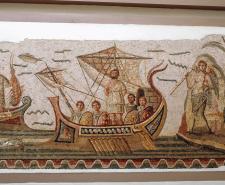
Sirens: from Greek bird-women to mermaids
In Greek mythology, sirens were initially said to resemble human women spliced with birds. In The Odyssey, Odysseus has himself tied to his ship’s mast to resist the allure of sirens’ seductive song. Anyone who did succumb to this temptation risked death. It’s no accident that in the modern age, women perceived to be attractive but dangerous are still referred to as ‘sirens’.
In later accounts, sirens would be depicted as mermaids. Today, there is no conclusive scientific evidence that mermaids were ever an actual thing. Nonetheless, there have been plenty of well-documented mermaid hoaxes. These include the ‘Fiji mermaid’ exhibited in the early 19th century. As recently as 2012, a mock documentary pretended to finally ‘prove’ the existence of mermaids – but it was all just an entertaining sham.
For more on the mysteries beneath the waves, sign up to the Sky HISTORY newsletter. Every week, you’ll receive the latest articles, episodes and more delivered straight to your inbox.


