

Kristallnacht: What happened on the ‘Night of Broken Glass’
What was the Night of Broken Glass in Germany? In November 1938, Nazi-led mobs destroyed Jewish homes, shops and synagogues. Here’s the story.
Image credit: Magdeburg, destroyed Jewish-owned shop, November 1938 . Bundesarchiv, Bild 146-1970-083-42. Licensed under CC BY-SA 3.0 DE
Once Adolf Hitler became chancellor of Germany in 1933, the new Nazi regime soon started rolling out policies discriminating against Jewish people. The warning signs had been there in Mein Kampf, the autobiographical literary work where, in 1925, the future Führer had laid out his antisemitic grievances.
As early as April 1933, Jews were banned from the German civil service. With the passing of the Nuremberg Laws in 1935, the half-million Jewish residents in Germany were no longer even technically German citizens. Jews were also prohibited from marrying non-Jewish Germans.
The Sky HISTORY docuseries World War II with Tom Hanks shows how the Nazi Party’s repressive measures intensified during the 1930s. Things took an especially dramatic turn for the worse with ‘Kristallnacht’, known as the ‘Night of Broken Glass’. We at Sky HISTORY reveal why this shocking episode can be seen as a major step towards the genocidal horror of the Holocaust.
How a diplomat’s death set off a dangerous spark
Thousands of Jews living in Nazi Germany were actually of Polish nationality. However, in October 1938, Nazi authorities began forcibly expelling these Jews. About 17,000 were sent to Poland, only to realise that the similarly antisemitic powers-that-be in their native land did not want them either.
The Polish Jews caught up in this awkward push-and-pull included Sendel and Riva Grynszpan. When their 17-year-old son Herschel Grynszpan heard of his parents’ plight (he was in Paris at the time), he headed to the German embassy. There, he confronted the German diplomat Ernst vom Rath and, incensed at the Nazis’ expulsion of the Polish Jews, shot him.
When word reached the Nazis, they had just the excuse they needed to turn the screw on the Jews still lingering in Germany. Hitler’s propaganda minister Joseph Goebbels declared that, in keeping with the Führer’s wishes, antisemitic ‘demonstrations should not be prepared or organised by the party’. However, ‘insofar as they erupt spontaneously, they are not to be hampered.’
Why is it called Kristallnacht, or the ‘Night of Broken Glass’?
On 9th November 1938, thousands of Jews across the Reich were shocked to wake up to find their businesses, synagogues and even homes being ransacked. Berlin and Vienna (at that time part of the German Reich), with their especially large Jewish populations, bore the brunt of the violence and destruction.
Thousands of Jewish sites, including workplaces, schools and cemeteries, were wrecked, with scrolls from the synagogues being sacrilegiously burned. In the aftermath of the carnage, many streets were strewn with glass shards from the smashed windows of Jewish establishments. Hence, Kristallnacht, which means ‘Crystal Night’ in German and is usually translated into English as the ‘Night of Broken Glass’, is now often called the November pogrom.

Who were these thugs? Just a bunch of random troublemakers? Not quite. Ordinary German citizens did take part in the rioting. Much of it, though, was actually the work of Nazi paramilitaries like the Sturmabteilung (SA) and Schutzstaffel (SS). The Nazi Party’s youth wing, the Hitler Youth, also took part. In essence, Nazi higher-ups were orchestrating the attacks, all while aiming to make them look like spontaneous outbursts from the public.
What happened on the night itself?
The chaos of Kristallnacht began on the evening of 9th November 1938 and continued well into the following day. All the while, German police and fire services were under strict orders from the government not to intervene. Jewish-owned buildings would literally be left to burn, with firefighters only stepping in to douse any flames spreading to adjacent, non-Jewish-owned buildings.
Jews were also physically assaulted and even killed on the Night of Broken Glass in Germany. Overall, at least 91 Jews are thought to have lost their lives in the Kristallnacht violence, according to the Nazis’ own count.
What happened to Germany’s Jews after Kristallnacht?
The violence was only part of it. In the following days, the SS and Gestapo arrested around 30,000 Jewish men, many of them wealthy or prominent, and about 26,000 were sent to the concentration camps at Dachau, Buchenwald and Sachsenhausen. Some were marched through their own streets past watching neighbours. Most were released over the following weeks, but only if they agreed to emigrate and hand over their property, and hundreds died in the camps.
The regime then made the victims pay. On 12th November, at a meeting chaired by Hermann Göring, the Nazi leadership imposed a collective fine of one billion Reichsmarks on the Jewish community, officially as ‘atonement’ for the shooting of Ernst vom Rath. Jews with more than 5,000 Reichsmarks in assets had to surrender a fifth of them to the state. They were also forced to pay for repairs to their own wrecked property, and their insurance payouts were confiscated. The fine was far more than the estimated cost of the damage.
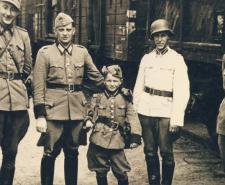
Further decrees pushed Jews out of German economic life altogether. From the start of 1939, they were barred from running retail businesses and trades, and Jewish-owned businesses were taken over in a process the Nazis called ‘Aryanisation’. Jewish children were also expelled from German state schools.
Between the violence, the arrests and the new restrictions, thousands of the surviving Jews were left clamouring to leave Germany. Foreign governments condemned the horrific scenes but remained reluctant to welcome many Jewish refugees. This only emboldened the Nazis further.
Though hundreds of thousands of Jews did flee Germany in the 1930s, escape became much harder after World War II’s outbreak in September 1939. During the war, about six million Jews from Germany and German-occupied lands died in the colossal genocide now commonly known as the Holocaust. News of Nazi atrocities only strengthened the Allied powers’ resolve to bring about Germany’s surrender, which eventually arrived in May 1945.
For more on the history of the Nazi era, sign up to the Sky HISTORY newsletter. Every week, you’ll receive the latest articles, episodes and more delivered straight to your inbox.


