

The Odyssey: Who is Agamemnon?
Benny Safdie's Agamemnon is one of The Odyssey's most talked-about characters. But who is Agamemnon in the original Homer – and did he actually exist?
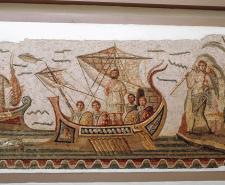
Image: 5th century depiction of Agamemnon | Public Domain
Social media has been on fire with chatter about The Odyssey, visionary director Christopher Nolan’s big-screen adaptation of the identically titled Ancient Greek epic. However, despite the huge critical acclaim garnered by the film, there has been more than a little controversy about some of Nolan’s creative decisions.
These include the depiction of Mycenaean warrior king Agamemnon, whose dark headwear has been likened more to Batman’s cowl than an Ancient Greek soldier’s helmet. Is this criticism deserved? To make an impartial judgement on that, you need to know how the character comes across in the original poem.
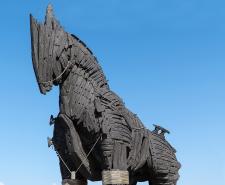
Agamemnon features not only in this verse but also its predecessor the Iliad – which, like the Odyssey, has been credited to Homer. This iconic poet’s literary work largely focuses on the city of Troy, which was rediscovered in the late 19th century. Exactly how is revealed in Sky HISTORY’s Troy Story, but what do we also know about Agamemnon, who supposedly besieged the city?
Who is Agamemnon in the Odyssey?
Even if you’ve only seen the trailers of the Nolan film, you’ve likely caught sight of the on-screen Agamemnon, played with brooding intensity by Benny Safdie. With his steely composure and imposing armour, Safdie’s Agamemnon has even been hailed on social media for his ‘aura farming’ (deliberate ‘coolness’).
In Ancient Greek mythology, Agamemnon ruled Mycenae, one of many Greek states that would send troops to fight in the Trojan War. Why did this conflict, which supposedly occurred around the 13th or 12th century BC, start in the first place? It all allegedly kicked off after the Trojan prince Paris lustfully stole Helen, the wife of Menelaus, the king of Sparta (and Agamemnon’s brother).
Agamemnon agreed to take command of an army that would attack the city of Troy and bring Helen back to Sparta. The Iliad is set towards the end of the resulting decade-long war, and explores Agamemnon’s tumultuous relationship with one of his most formidable troops, Achilles.
How Agamemnon angers Achilles
In the Iliad
, Agamemnon enslaves a woman called Chryseis. After her father Chryses and the prophet Calchas called on Agamemnon to release her, and Apollo sent a plague upon the Greek camp to reinforce the demand, he reluctantly did so. To replace her, he nabs Achilles’s own concubine, Briseis. Achilles himself is left none too pleased, and refuses to continue fighting in the war.
As the Trojans start gaining serious ground in the war, Agamemnon panics. He’s evidently paid a high price for upsetting his talisman, but doesn’t have to wait too long for him to return. As Achilles’s friend Patroclus gets right into the thick of the battle, he is slain by the Trojan prince Hector. Determined to avenge Patroclus’s death, Achilles rejoins the fight, turning the tables on the Trojans.
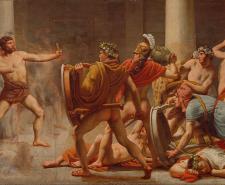
Agamemnon’s relationship with Odysseus
If it’s possible to post spoilers for poetry likely written around the 8th century BC, you might want to look away now. Homer’s Odyssey follows another Trojan War hero, Odysseus, as he strives to return to his own Greek kingdom, Ithaca. Along the way, he stumbles into the underworld, where he meets the deceased Agamemnon and finds out how he met a grisly end.
Agamemnon explains that, shortly after returning home from the war, he was ambushed and killed by his wife Clytemnestra’s extramarital lover Aegisthus. Agamemnon fears that a similar fate could await Odysseus if he meets back up with his own wife, Penelope.
In the event, however, Penelope turns out to be unfailingly loyal to her husband, having resisted the advances of 108 suitors, including the dastardly Antinous. That Odysseus gets to romantically reconnect with his beloved only further underlines the tragedy of Agamemnon’s own predicament.
Did Agamemnon actually exist?
The Trojan War was said to have taken place several centuries before Homer composed the Iliad and the Odyssey. So, it would have been easy for early readers of his work to assume that it reported on a real historical event. It’s not like they would have been able to easily fact-check what Homer was telling them.
As Homer’s verse features mortals interacting with deities, most modern scholars consider Agamemnon a mythological figure rather than a historical one – no more literally real, perhaps, than Robin Hood. This doesn’t rule out the possibility that Agamemnon and other characters in the Odyssey were still heavily based on real-life Ancient Greeks and Trojans.
For more on the myths, legends and ancient epics that continue to shape how we understand the past, sign up to the Sky HISTORY newsletter. Every week, you'll receive the latest articles, episodes and more delivered straight to your inbox.


