

From myth to IMAX: The history behind Christopher Nolan’s Odyssey
Homer’s Odyssey has had a lasting legacy. How have the adventures of Odysseus been retold over the centuries, right through to the Christopher Nolan film?
Image: Christopher Nolan and Emma Thomas attend 'The Odyssey' London Premiere at Odeon Luxe Leicester Square on July 06, 2026 in London, England. (Photo by Jeff Spicer/Getty Images for Universal Pictures) | 2026 Getty Images
Esteemed film director Christopher Nolan’s The Odyssey has sparked plenty of excitement. An adaptation of the hugely influential Ancient Greek epic of the same name, its star-stacked cast includes Matt Damon, Anne Hathaway and Robert Pattinson.
It’s also the first film shot entirely on 70mm IMAX cameras. However, in the run-up to its release date, controversy soon grew. Observers took issue with what they perceived to be a litany of historical inaccuracies in early images and clips from the film. Some of the casting choices were also deemed unfaithful to the source material credited to the Ancient Greek poet Homer.
Had Nolan finally lost the plot, both literally and figuratively? Had he even read the adventures of Odysseus, the fictional warrior-king? As Sky HISTORY reveals in the series Troy Story, the historical ‘truth’ of Homer’s work is rather more complex than often realised.
What happens in Homer’s Odyssey?
Who is Odysseus? You might call him the OG ‘antihero’ — the Batman of Ancient Greece, if you will. In other words, an action hero, but one with very relatable flaws. He fought for ten years in the Trojan War, which (according to Homer) raged during the Mycenaean era, itself part of the late Bronze Age.
The story of this conflict is told in The Iliad, another epic poem supposedly penned by Homer. After helping his fellow Achaean troops to successfully besiege the city of Troy, Odysseus starts the long trek back to his home island of Ithaca. In The Odyssey, we find him still trying to reach it a decade after the war.
Yes, this means Odysseus has been away from home for two decades. His wife Penelope and son Telemachus are still waiting for him. However, the dastardly Antinous of Ithaca is just one of 108 suitors now vying for Penelope’s hand in marriage. Can Odysseus return to the island in time to fend off these love rivals?
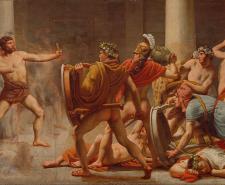
Are the adventures of Odysseus historical fact?
Troy itself was seemingly uncovered by archaeologists in the late 19th century, and the city’s remains show damage consistent with wartime destruction. Still, most of the narrative told in Homer’s Odyssey
is considered fictitious — especially given its fantastical elements, including deities, monsters and magic.
Even the poem’s more grounded aspects are littered with historical inaccuracies. Though The Odyssey is supposed to be set around the 12th century BC, it incorporates elements from Homer’s own time, roughly the 8th century BC. This may reflect how the poem originally came together, as it would have been regularly recited orally long before it was written down.
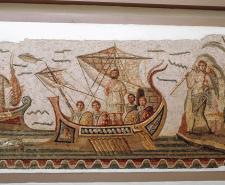
How retellings of The Odyssey have varied
Nolan has been criticised in some quarters for some of his casting decisions. However, such criticism ignores how Homer’s work has been regularly reinvented over the centuries.
As much of the original Greek text does not easily translate into English, there have been major differences even between mere ‘translations’ of the poem. For example, while early male translators depicted female characters unflatteringly, academic Emily Wilson excised such misogynistic language from her own 2017 translation.
Often, how The Odyssey is retold very much depends on the distinct sensibilities of the age in which it is retold. After Christianity became the dominant faith across the Greek world, Italian poet Dante Alighieri’s 14th-century Inferno depicted Odysseus in hell.
Similarly, James Joyce’s 1922 novel Ulysses was in-keeping with the cultural movement of Modernism taking hold at the time. In the 21st century, writers Margaret Atwood and Madeline Miller have put feminist spins on Homer’s Odyssey, retelling it from the POVs of female characters. In 2026, there’s even a new audiobook of Homer’s Odyssey narrated in Michael Caine’s AI-recreated voice.
Christopher Nolan’s take on The Odyssey
Has Nolan portrayed the adventures of Odysseus in a historically authentic way? Given that the original story is mere myth, it would arguably be an impossible task in the first place. Nolan himself is well aware of this creative quandary, judging from the film’s trailer.
So, we see Telemachus calling Odysseus his ‘dad’, while the Ithacan king’s ship in the trailer looks a lot more Viking than Ancient Greek. However, far from jarring, such touches are testament to the cultural elasticity of Homer’s Odyssey and how easily it can be adapted for new audiences.
Love following the adventures of Odysseus? You can clue yourself up on many other enchanting tales of the past (both real and mythical) by subscribing to the Sky HISTORY Newsletter.


