
Emily Davison: The woman who gave her life for the suffragette movement
In 1913, suffragette Emily Wilding Davison stepped onto the Epsom Derby track – and was fatally struck by the king's horse. Was it suicide or something else?
Image: Emily Davison died after colliding with a horse at the 1913 Epsom Derby | Public Domain
8th June 1913 was supposed to be just another day at the Epsom Derby, one of England’s premier annual horse racing competitions. The gathered crowds were particularly giddy to see King George V’s horse Anmer sprinting across the finishing line.
So imagine their shock when, that day, the royal steed had a sudden, nasty accident on the track. At first, it wasn’t entirely clear what had happened. The horse rolled over, the jockey having been thrown from his saddle. Onlookers rushed to the scene as they also saw someone else lying motionless on the turf.
It was Emily Wilding Davison, the suffragette who had spent years campaigning to get the vote for women. Had she intended to sacrifice herself, or was this another act of political protest? Davison’s death denied the world answers, but now Sky HISTORY examines the clues to what really happened that day.
Who was Emily Wilding Davison?
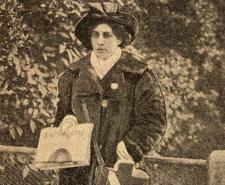
Emily Wilding Davison was born to an affluent London household on 11th October 1872. In the 1890s, she started studying at Royal Holloway College but had to leave after her father Charles’ death threw the family into financial disarray.
Davison later achieved first-class honours at the University of Oxford, but tragically at a time when the institution did not award degrees to women. After working as a teacher and governess, Davison joined the Women’s Social and Political Union (WSPU) in 1906.
The WSPU was a militant organisation demanding women’s right to vote – ‘suffrage’ – in the UK. For this reason, they became known as ‘the suffragettes’. Its members became notorious for their physically destructive campaigning methods, including breaking windows and setting fire to postboxes.
Davison herself indulged in such practices, landing her several stints behind bars. While in prison, she tended to embark on hunger strikes, leading her to be force-fed. In an attempt to prevent this, she once barricaded herself in her cell.
On one occasion, Davison even threw herself from a prison balcony and onto an iron staircase. She later admitted that she had hoped the fall would be fatal, as ‘one big tragedy may save many others’. With these reckless acts, her ultimate aim was to pressure the government into finally giving women the vote.
What happened to Emily Davison at the Epsom Derby?
Davison’s exact intentions that day are shrouded in mystery. At first, contemporaries only knew that she had ventured onto the track during a race and been struck unconscious by the king’s horse.
She was sent to Epsom Cottage Hospital – where, four days after the incident, she died of a fracture to the skull, aged 40. As Davison had not told WSPU leaders beforehand what she planned to do at the Derby, she ended up taking this secret to the grave.
Given Davison’s history of suicidal behaviour, had she resorted to it yet again? The coroner decided otherwise, recording her death as accidental. Close analysis of video footage (press cameras captured the incident from three different angles) since then has supported this verdict.
One popular theory is that Davison was trying to hang a WSPU flag on the king’s horse. Recent analysis indicates that Davison would have had a clearer view of the oncoming horses than has often been assumed. This puts paid to the earlier suggestion that she could not have been targeting Anmer specifically.
Also, Davison’s possessions recovered from her person included a return train ticket and a ticket to a dance scheduled for later that day. These findings further strengthen the notion that Davison had not sought her own death at Epsom.

Emily Davison’s impact on the suffragette movement
Public reaction to the Epsom tragedy was mixed, much as it had been to the suffragette protests more generally. Davison’s encroachment on the race track was seen as irresponsible, and she received hate mail while in hospital.
Among her fellow suffragettes, however, she declared a heroic martyr for their cause. Her funeral in London attracted thousands of spectators before her body was buried in the Northumberland hometown of Morpeth, where her parents originally hailed from.
In the UK, women over the age of 30 meeting specific property thresholds were finally granted the vote after the First World War. It wasn’t until 1928 that British women were finally bestowed with voting rights on the same terms as men. The story of Emily Davison inspires feminists to this day.
For more on the extraordinary individuals who shaped British history, sign up to the Sky HISTORY newsletter. Every week, you'll receive the latest articles, episodes and more delivered straight to your inbox.


