
What kind of swords were used in the Trojan War?
What did the swords look like in the Trojan War? As a Sky HISTORY series looks afresh at the legendary conflict, we assess how it could have been fought.
Image: The Burning of Troy by Francisco Collantes from the 17th century | Public Domain
There have been many incredible swords in history, but some are much better documented than others. For example, while you can see the Sutton Hoo sword on display at the British Museum in London, King Arthur’s Excalibur is practically mythical.
Many famous swords are strongly associated with specific historical eras. One of those you might have in mind is the Trojan War, the subject of the new Sky HISTORY series Troy Story. So, what did the swords look like in the Trojan War?
We can’t be absolutely certain, as it’s far from clear whether this ancient Greek conflict even happened in the first place. Still, that’s not stopped us at Sky HISTORY speculating about what kind of swords the combatants would have wielded if it did happen.
What was the Trojan War?
The Trojan War is reputed to have taken place around the 12th century BC. The story is that the Trojan prince Paris was asked to adjudicate a quarrel between the goddesses Hera, Athena and Aphrodite. Which of them was the ‘fairest’?
Paris settled on Aphrodite, as she had promised him the love of the world’s most beautiful woman, today popularly known as ‘Helen of Troy’. At the time, though, she was really Helen of Sparta - the wife of that Greek city-state’s king, Menelaus.
Unsurprisingly, Menelaus was none too pleased about Paris taking Helen with him to his homeland, Troy. The Spartan leader orchestrated a siege against this coastal city in a bid to retrieve Helen.
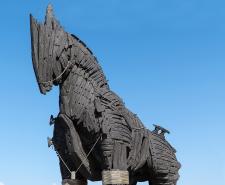
The Greeks made little progress in this endeavour until they tricked the Trojans into accepting the supposedly well-intentioned gift of a giant wooden horse. It actually contained Greek soldiers who went on to physically obliterate Troy, bringing the war to a brutal end.
What year was the Trojan War?
Ancient sources don’t go into specifics about the Trojan War’s start and end dates. However, it is commonly said to have occurred towards the end of the Bronze Age.
The traditional story of the Trojan War is predominantly derived from the ancient Greek poet Homer’s epic the Iliad. However, this account can’t be taken as entirely factual, as it weaves in various fantastical elements and was written centuries after the war supposedly occurred.

Could the Iliad still be incorporating at least a kernel of historical truth? In the late 19th century, archaeologist Heinrich Schliemann did find remains of an ancient city matching Homer’s description of Troy - right down to its surroundings. These remains have been scientifically dated to the alleged time of the Trojan War.
What did the swords look like in the Trojan War?
Tantalisingly, parts of swords (including pommels) have been found at what many modern historians now regard as the real Troy. However, these incomplete specimens tell us little. Much more intact Bronze Age swords have been found elsewhere, but are likely similar to those that would have been wielded in a hypothetical Trojan War.
At the onset of the Bronze Age, the use of daggers was de rigueur in close combat. Centuries later, the archetypal dagger design had been revised, with the blade made narrower to form what we would now recognise as the sword.

By the late Bronze Age, spears and slings were still widely favoured over swords, which tended to be used as secondary weapons. Tellingly, the Iliad makes only fleeting references to swords, but several of the epic’s major characters are described as carrying them.
Many swords of the Trojan War era would have been made from bronze (an alloy of copper and tin). Nonetheless, it would not have been unusual for them to also come with decorative elements of other metals, like silver and gold.
Do the alleged swords of the Trojan War align with historical fact?
Of course, many details about the Trojan War remain of dubious historical authenticity. One memorable moment of the Iliad sees Achilles almost attempt to use his own sword to kill Agamemnon. However, both characters are ultimately seen as legends rather than widely believed to have genuinely existed.
All the same, Homer armed these mythological parsonages with swords appropriate for the period where the Trojan War story is set. This all suggests that the poet purposefully drew upon elements of historical fact even when writing what many of today’s readers would deem mere fable.
What did the swords look like in the Trojan War? There’s no way to be certain. However, it’s easier to come up with convincing theories when you deepen your historical knowledge by subscribing to the Sky HISTORY Newsletter.


