
A historian explores how secret intelligence fractured Churchill and de Gaulle’s WWII alliance
Winston Churchill and Charles de Gaulle were uneasy allies during WWII. Dr Matthew Hefler reveals how secret intelligence, espionage and intercepted messages helped drive them apart.
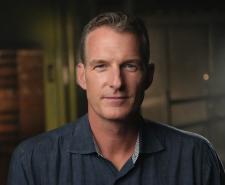
Image: Dr Matthew Hefler is an expert contributor to Sky HISTORY's new docuseries 'World War II with Tom Hanks' | World War II with Tom Hanks
In this guest article, Dr Matthew Hefler, an expert in international and intelligence history at the Stockholm School of Economics, uncovers how espionage deepened the mistrust between Winston Churchill and Charles de Gaulle. While Britain and the Free French were united against Nazi Germany, their wartime alliance was undermined by suspicion, intercepted messages and covert intelligence gathering on one another.
Dr Hefler explores this fractured alliance in his upcoming book, Churchill and de Gaulle: Secret Intelligence and the Failure of Franco-British Relations, and is also an expert contributor to Sky HISTORY's new docuseries, World War II with Tom Hanks, available now on Sky HISTORY.
During World War II, Winston Churchill had a notoriously difficult relationship with Charles de Gaulle. The reasons for this are well known. On one hand, the Leader of the Free French could be difficult. De Gaulle viewed himself as the embodiment of French interests, and, with few cards to play, saw yelling and banging his fists on the table as one way to get what he wanted. Churchill, on the other hand, found de Gaulle’s obstinance inconvenient. He saw de Gaulle as putting French interests above the war effort and found him ungrateful for Allied assistance given the Free French. These divisions led to frequent explosions between the two men that threatened to break Franco-British cooperation during WWII.
Less well-known is how secret intelligence contributed to the poor Churchill-de Gaulle relationship. True, intelligence cooperation brought some Allies together, as with the US and the UK – and there was lots of collaboration between British services, like the Special Operations Executive (SOE) and de Gaulle’s Bureau central de renseignements et d'action (Central Bureau of Intelligence and Operations – BCRA). Yet while the Anglo-American allies refrained from significant espionage against one another, the British and French spied on one another with an enthusiasm that only these traditional “frenemies” could muster.
Today, declassified intelligence material shows that espionage, subversion and covert political action played important roles in Franco-British relations. Readers can learn all about this in my forthcoming book, Churchill and de Gaulle: Secret Intelligence and the Failure of Franco-British Relations, coming December 2026. For now, we can glance at the way these leaders approached intelligence and how it shaped their views of one another. During WWII, intelligence reinforced de Gaulle’s suspicions of British intentions and Churchill’s perception of de Gaulle as interfering and ungrateful, increasing the mistrust between them and shaping wider Franco-British relations.
The secret war behind the alliance
Secret intelligence rarely works in a straightforward manner. While intelligence can help reduce the uncertainty faced by decision-makers, just as often it works in ways that seem counterintuitive or which are shaped by the contingency of history. This is especially true of diplomatic intelligence, which tends to be ambiguous, lending itself to support existing positions or preconceptions. This was often the case with intelligence in the Churchill-de Gaulle relationship, as two larger-than-life figures sought to understand, outwit, and undermine the other.
Churchill's window into French secrets
Churchill and de Gaulle brought different experiences and attitudes to intelligence. Churchill loved spies and secret services. By the time he came to power in 1940, amid the Fall of France, he had more experience with intelligence than any previous British Prime Minister. Churchill had been part of the government that established the formal secret service in 1909, had dealt with it during the First World War (and beyond) and had an appreciation of the strengths of intelligence, and of what questions one could ask of it.
Unlike previous leaders, Churchill insisted on seeing not just intelligence reports but raw intelligence, especially signals intelligence such as that produced by Bletchley Park. Churchill received a personal intelligence dossier daily from the head of the Secret Intelligence Service (SIS/MI6), Major General Stewart Menzies or “C”, essentially the figure of “M” in the James Bond films. The dossiers contained intercepted material about German military operations, including ULTRA and intercepted Enigma material, but also intercepted diplomatic cables from around the world, including extensive French correspondence.
Today these dossiers are available to view at the UK National Archives in Kew and they offer an exceptional window into Winston Churchill as an intelligence consumer. The prime minister was especially interested in the French. In April 1944, Churchill asked the Permanent Under-Secretary at the Foreign Office, Alexander Cadogan, whether they were reading the French Ambassador’s telegrams to de Gaulle in Algiers and, if so, what they were like. Cadogan explained that they did see these telegrams, though there had been a gap earlier in the year when the ambassador had changed his ‘recyphering tables’. At the moment, however, they were being provided regularly.
Why de Gaulle feared British interference
Charles de Gaulle tends not to be remembered as quite such an intelligence enthusiast as Churchill. Some of this was established through unfortunate episodes early in the war. In August and September 1940, the British and the Free French tried to take the important French West African port of Dakar, but the operation failed. The failure hurt de Gaulle’s standing, but things got worse when the British Security Service, MI5, blamed the failure on poor security in the Free French camp and on de Gaulle specifically. This episode led Allied military leaders to leave de Gaulle further in the dark on military plans for the rest of the war, even when these related directly to France – something that aggravated de Gaulle’s suspicions and his sense of responsibility.
Things got worse still a few months later, when MI5 arrested French Admiral Émile Muselier in January 1941. This took place on Churchill’s orders on the basis of what turned out to be forged documents from inside de Gaulle’s own secret services, the BCRA. In this instance, Muselier was released and Churchill even apologized. But these were key episodes that shaped our perception of de Gaulle as at best a reluctant consumer of intelligence.
The Levant crisis
Yet de Gaulle could see the value of intelligence, especially when it came to protecting the French Empire. All throughout the war, the Free French accused their British allies of trying to undermine their position in the French Levant States of Syria and Lebanon. This suspicion fit with de Gaulle’s natural inclinations as a French officer of his generation, for whom British intentions were always suspect, but also as with his experience in the region: he had served for two years in the Levant and seen first-hand the intensity of the Franco-British imperial rivalry there.
The issue had already caused major rows between de Gaulle and Churchill in 1941 and 1942 but it blew up in November 1943, when Lebanese leaders tried to end the French mandate over their country. The French, believing that British agents were involved, had reacted harshly, and only an Anglo-American ultimatum – threatening to break with the French entirely – had forced de Gaulle down. Many French leaders hoped the issue would go away. Whether or not de Gaulle’s suspicions were correct, they argued, France would need British support after the war. But the gods of intelligence had different ideas.
By the summer of 1944, a French intelligence officer had recruited exceptional agents in Damascus and Beirut. Stolen documents poured in to de Gaulle and outlined the way some British political and intelligence officers were supporting local politicians against the French position in the Levant. The intelligence helped confirm de Gaulle in his suspicions of British intentions. It stiffened his determination to defend French interests and led him toward a showdown with Churchill over the region.
The D-Day telegram that enraged Churchill
However, Churchill had intelligence of his own, and it shaped his views of the general. In June 1944, just days before D-Day, when Allied forces were to land on the beaches of Normandy – and begin the liberation of France – he and de Gaulle had another of their explosive encounters. Churchill wanted de Gaulle to make a radio address to the French in support of the landings, but de Gaulle, who had been left out of the planning for the liberation, made this more difficult than necessary. Churchill left the altercation fuming. Intelligence made things worse just days later, when Churchill’s private dossier from C included an intercepted copy of de Gaulle’s telegram to his colleagues in which he described the encounter. De Gaulle had referred to the meeting disdainfully as an effort by Churchill to give the invasion la couverture française or “French cover”.
Today, we can understand the difficult circumstances in which de Gaulle was trying to keep a defeated France together. But we can also imagine how Churchill, who had just sent thousands of British, Canadian, and American boys ashore against heavy enemy resistance, would feel about de Gaulle’s framing. In his dossier, the prime minister penned aggressive circles around de Gaulle’s words.
How spies turned suspicion into certainty
Declassified intelligence material gives us a sense of leaders like Churchill and de Gaulle not just as intelligence consumers, but as men, as clashing personalities, and shows how these could combine with intelligence to shape global statecraft. For de Gaulle, intelligence made it seem that Churchill was allowing his services to undermine the French in the Middle East. For the prime minister, intelligence reinforced his perception that de Gaulle was more interested in advancing French interests – and his own position – than in helping the Allies who were doing the bulk of the fighting.
As the war ended, Churchill had come to see de Gaulle as a real danger to Britain’s alliances and interests. De Gaulle felt the same. A final clash between the pair emerged in the Levant in June 1945. The French had tried to violently crush popular protests and British forces intervened, occupying the region. The French position was all but shattered. De Gaulle claimed openly that British intelligence agents had instigated the trouble by undermining France. Few paid much attention to his accusations. But de Gaulle summoned the British ambassador and made a grim remark: “We are not, I admit, in a position to open hostilities against you, but you have insulted France and betrayed the West. This cannot be forgotten.”
The episode is another tragic one for supporters of Franco-British cooperation. But it tells us about Churchill and de Gaulle as leaders and as intelligence consumers. Both men had some good intelligence on one another. The material was of different kinds, but for both leaders it reinforced their perceptions of the other. De Gaulle’s intelligence shed light on one of his key preoccupations – perceived threats to the integrity of the French Empire. It helped confirm his suspicious but could not aid him in preventing the blow. Meanwhile, Churchill’s codebreakers dominated French communications. Intercepted cables helped confirm his perception of de Gaulle as a man and an ally – and reinforced his belief that de Gaulle was more out for himself than the Allied war effort. Both men read ambiguous intelligence to confirm their preconceptions of the other.
During WWII, intelligence helped push Winston Churchill and Charles de Gaulle apart. But it could also bring Allies together. To see how intelligence played a critical role in the Allied victory in war, be sure to watch World War II with Tom Hanks, available now on Sky HISTORY.


