

The story of the Clash of Nations: Joe Louis vs Max Schmeling
In 1938, Joe Louis and Max Schmeling fought as symbols of Nazism and democracy. Here's the surprising friendship that outlasted the politics.
Image: The Clash of Nations: Joe Louis vs Max Schmeling
Rivalries are nothing new in the world of sports. From Joe Frazier vs Muhammad Ali to Senna vs Prost, rivalries are what make sport so compelling. However, very few carry as much political weight as the 1938 boxing match between Joe Louis and Max Schmeling.
The fight was significant on a personal level, as both men were competing for a chance at the world heavyweight boxing championship. The political aspects of the fight came from the socio-political climate of the 1930s in Louis’s home country of America and Schmeling’s native Germany.
The story of the fight is retold in Sky HISTORY’s new documentary, Clash of Nations: Joe Louis vs Max Schmeling. Ahead of the documentary airing on Sunday 4th October, this article examines how a single boxing match became a proxy battle between Nazi propaganda and the fight for racial justice in America.
Joe Louis and Max Schmeling
Their backgrounds, on opposite sides of the Atlantic, would shape what the fight came to represent. We start in Alabama, where a sharecropper's son would become a national symbol.
Joe Louis: from Alabama poverty to the ‘Brown Bomber’
Joseph Louis Barrow was born in Lafayette, Alabama, on 13th May 1914. He was born into poverty, was one of seven children, and had a family history rife with slavery. Louis was the grandson of a slave, but also the great-grandson of a slave owner. When he was still a child, Louis’s mother moved her family to Detroit. This was due to the lack of job opportunities and the rising violence against African Americans in the South caused by the far right Ku Klux Klan group.
Louis went on to become a dominant force during the ‘Golden Age’ of boxing (from around 1930 to the mid 1950s). Nicknamed the ‘Brown Bomber’, Louis held onto the title of world heavyweight for just over a decade (from June 1937 to June 1948).
Louis was an important cultural figure, often considered the first African American to become a boxing legend in the US. The timing of his reign was also notable, as it fell during World War II. Because of this, he became a symbol of sorts against right-wing Nazi fascism.

Max Schmeling
Much like Louis, Max Schmeling was a heavyweight boxing champion. He was born in Brandenburg, Germany, on 28th September 1905. He got into boxing when he was a teenager after his father showed him a film of a heavyweight championship fight between Georges Carpentier and Jack Dempsey. By 1924, Schmeling had won the national amateur title in Germany. Schmeling held the heavyweight champion of the world title between 1930 and 1932.
In January 1933, Adolf Hitler rose to power with the Nationalist Socialist Party, known globally as the Nazi party. Despite not being a member of the party, and not sharing their values, Schmeling became a propaganda symbol for the Nazis. His image and success as a boxer was often used by Hitler to demonstrate the supremacy of the Aryan race.
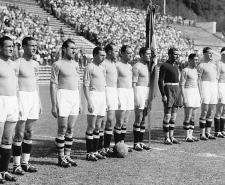
Schmeling was far from a supporter of the regime. Although he played nice where he could, such as by having dinner with Hitler, he angered top-ranking Nazi officials by refusing to join the party. He was also told to fire his Jewish American manager and divorce his Czech movie star wife Anny Ondra. Schmeling once again refused, which led to animosity.
How Louis vs Schmeling became the fight of the century
In June 1936, Schmeling won a match against Joe Louis, which led to the Nazi party putting him on a pedestal and claiming racial superiority. A rematch took place in June 1938, attracting around 90,000 spectators.
This fight became more than a simple rematch. It symbolised the fascist regime of Nazism – represented by Schmeling – against the emancipation of the black community and the fight for democracy and freedom, represented by Louis. Although Louis was proud to represent the American people, and the black community, Schmeling fought for a government and for principles that he did not support.
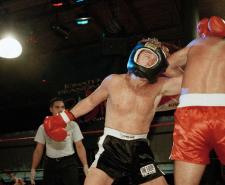
Spurred on by his initial defeat, Louis dominated the rematch. He won the fight two minutes into the first round. Louis floored Schmeling in the first round, winning via a technical knock out.
Both Schmeling and Louis carried the weight of their respective worlds on their shoulders in their bouts. Louis won the final fight, but Schmeling’s 1936 victory was not to be scoffed at. Louis’s victory is still considered a victory for freedom and democracy. Schmeling has also managed to break away from the media portrayal of him as a pawn for the Nazi party. It was even revealed many years later that Schmeling had saved Jewish children and helped them escape from Germany, risking his life in the process.
Schmeling and Louis formed a friendship once their boxing careers were over. He even provided financial assistance to Louis and paid for some of the funeral arrangements after his death in 1981. Schmeling was also a pallbearer at Louis’s funeral.
Louis and Schmeling represented so much more than they could have possibly imagined. That being said, in the end, they were simply two men who chose friendship over propaganda.
For more on sport's most politically charged moments, sign up to the Sky HISTORY newsletter. Every week, you'll receive the latest articles, episodes and more delivered straight to your inbox.


