
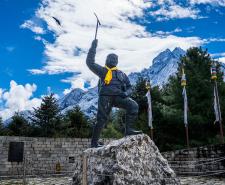
Edmund Hillary: The explorer who reached Everest and both poles
Edmund Hillary, the explorer who reached Everest’s summit with Tenzing Norgay in 1953, also reached both poles and transformed life for the Sherpas.
Image: Edmund Hillary | Public Domain / Background: Shutterstock.com
If you’ve recently been to New Zealand, you might recognise the name of Edmund Hillary, the explorer whose image features on the country’s $5 note. Pub-quiz regulars likely also know him as the first climber definitively known to have set foot on the summit of Mount Everest. The story of how he got there has been dramatised in the recent Apple TV film Tenzing, with Tom Hiddleston playing Hillary.
However, there’s so much more to the esteemed Kiwi mountaineer than even these glittering milestones. He was truly a ‘triple threat’, reaching not only Everest’s summit but also both the world’s poles. Through his philanthropy, he also significantly improved the lives of the Himalayan Sherpas. Time magazine named him one of the 20th century’s most influential figures.
Edmund Hillary passed away in 2008, but his achievements have long continued to inspire budding adventurers. After all, Hillary’s ambitious drive and genuine love of exploration had led him to essentially conquer not only Everest but also the world. Sky HISTORY looks at how a shy Auckland beekeeper became the first person to stand on both poles and the summit of Everest.
Edmund Hillary’s early life
Hillary was born on 20th July 1919 in the New Zealand city of Auckland. His father, Percival, was a beekeeper who had previously served in World War I. As a child, the shy and awkward Edmund had a difficult relationship with his strict father. Solace would come from the warmer, more nurturing touch of his mother Gertrude.
The young Edmund so excelled at primary school that he started at Auckland Grammar School two years early. Despite his middling academic marks during this period, his love of mountaineering would be awakened by a school trip up Mount Ruapehu. Hillary later started reading mathematics and science at Auckland University College, only to abandon his studies there after just two years.
Instead, Hillary joined his father’s beekeeping business. This conveniently enabled him to make money during the summer while keeping winter free for climbing. In a promising harbinger of things to come, Hillary reached the summit of Mount Ollivier in 1939, at the age of 19. His early run of mountaineering success was temporarily interrupted by World War II, when he served in the Royal New Zealand Air Force (RNZAF).

Edmund Hillary’s best-known expeditions
Edmund Hillary, knew that conquering the 8,848-metre-tall Mount Everest would be the ultimate prize. As the 1950s began, no climber had yet been known to reach the top. This didn’t stop teams from continuing to make new attempts. Hillary’s hard-earned expertise landed him places on several of these expeditions, including a British reconnaissance effort led by Eric Shipton in 1951.
The big breakthrough eventually came in 1953, when Hillary was recruited to a new mountaineering team led by British Army officer, John Hunt. Hillary would reach the summit of Mount Everest at 11:30am on 29th May 1953, with his colleague Tenzing Norgay following him up there swiftly after. While there, it was Hillary who captured the now-famous photograph of Norgay holding an ice axe flying four flags. The two men lingered for about 15 minutes at the summit, with Hillary opting to bury a cross there before his trek back down.
In 1958, Hillary took part in the Commonwealth Trans-Antarctic Expedition, reaching the South Pole. In 1985, Hillary flew with astronaut Neil Armstrong in a twin-engined ski plane, eventually landing on the North Pole.

Edmund Hillary: the explorer, the man, the legend
News of Hillary’s Everest conquest broke on the same day as Queen Elizabeth II’s coronation. Hillary was knighted, but still had plenty of other fish to fry. In the early 1960s, he revisited the Himalayan region to search for evidence of the legendary Yeti, otherwise known as the Abominable Snowman. No convincing trace of the fabled creature was found.
In 1960, Hillary also established the charitable Himalayan Trust, which would go on to fund schools and hospitals for the Sherpa people of Nepal. In the decades after his Everest feat, Edmund Hillary would collect accolades from various countries, including Britain, New Zealand and India. However, for all his achievements, his personal life wouldn’t be without tragedy, as he suffered the devastating loss of his first wife, Louise, and their daughter Belinda, in a Nepalese plane crash in 1975. Hillary had been building a hospital in the country at the time.
His death on 11th January 2008 prompted an immense outpouring of grief in New Zealand. The Kiwi government bestowed the prestigious honour of a state funeral for the explorer, who continues to be fondly remembered far and wide.
For more on the people who shaped history, sign up to the Sky HISTORY newsletter. Every week, you’ll receive the latest articles, episodes and more delivered straight to your inbox.


