

Woodling torture: The eye-popping pirate punishment
Woodling was one of the most notorious torture methods used by pirates. What did it involve and when was it used? What made it such a feared punishment?
Image: Shutterstock.com
During the late 17th and early 18th centuries, maritime raiding in the Atlantic and Indian Oceans reached unprecedented highs. Nonetheless, much of what you think you know about pirates likely has little to do with actual pirates.
The public’s perception of historical piracy has been distorted by popular books and films like Peter Pan and Treasure Island. For example, ‘walking the plank’ wasn’t actually a big thing.
There were, however, a multitude of other, more painful punishments inflicted by pirates. Among these was ‘woodling’ – a now little-known (but horrifically gruesome) technique we at Sky HISTORY were especially shocked to learn about.
How pirates meted out brutal torture
In the early modern era, pirates would raid coastal areas to nab gold, silver and other valuable goods. Still, pirates faced numerous obstacles along the way – especially since they were engaged in criminal activities.
Some of the innocent bystanders they came across could hoard treasure the pirates were trying to get their hands on. Pirate captains could also have to face down mutinies by crew members who felt they weren’t getting a fair deal.
In both scenarios, pirates would often dish out severe punishments. Disobeying shipmates could be flogged with the cat o’nine tails, while hoarders put under sustained duress could blab about where they were concealing gold.
What was the pirate torture method of ‘woodling’?
Many sailors were accustomed to wrapping cordage around masts during this period. It was just one of their many routine duties aboard ship. So, the principle behind woodling was pretty simple…
Firstly, a cord would be wrapped around the victim’s forehead. This cord was attached to a metal bar. This served as a makeshift lever that would be used to twist the cord.
As the cord was twisted, it would tighten around the head. Could this be enough to get the victim talking? If not, the torturer would tighten the cord further, exerting ever-more pressure on the head.
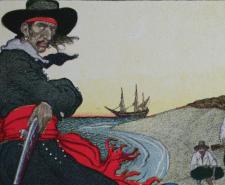
This could go on long enough for the victim’s eyeballs to start protruding from their sockets and eventually even burst out of the skull. Even if you survived such treatment, the harrowing memory of it would likely stay with you long afterwards.
Was woodling effective?
As alluded to earlier, pirates during the Golden Age of Piracy had a wide range of torture techniques at their disposal. These included keelhauling, where victims would be dragged under the ship’s keel. Others were made to run across the ship’s deck while being jabbed by onlookers.
However, woodling appears to have been reserved for extracting information (not just eyeballs) from targets. As historical accounts of woodling were prevalent enough to have survived to the present day, it must have been used relatively often.
This, in turn, suggests that it was proven to be effective. Many captives may have given up secrets simply due to the psychological horror of seeing that glinting metal bar and anticipating what was coming next.

Woodling also had the advantage of being easy to administer. It was not a complex process, but used materials that pirates already had close at hand. Hence, it did not require any major, time-draining preparatory work.
How Captain Henry Morgan put woodling to the test
One well-known buccaneer who practiced woodling is Captain Henry Morgan. Though often casually referred to as a pirate, Morgan was really more of a privateer, as he carried out raids with the English government’s permission.
One of Morgan’s most successful campaigns occurred in the Central American city of Porto Bello in July 1668. After landing in this Spanish-held territory (today part of Panama), Morgan and his men seized three castles.
Such was his determination to financially exhaust the city, Morgan had residents tortured into coughing up intelligence about where treasure was held. Woodling was one technique used at the Welsh-born privateer’s behest in Porto Bello.

As the saying goes, the proof of the pudding is in the eating…or the woodling. For the president of Panama, the situation in Porto Bello was so fraught that he paid the privateers a ransom of 100,000 pesos. Morgan’s reputation soared in England, eventually leading him to be knighted by King Charles II in 1674.
Look beyond the pirate stereotypes
The real world of pirates was far from the romanticised image propagated by modern popular culture. Woodling is just one example of the savagery to which pirates were prone.
Keen to (ahem) dive into more of maritime history? A good way to start is to subscribe to the Sky HISTORY newsletter.


