
Douglas Kelley: The psychiatrist at the Nuremberg Trials
Discover American psychiatrist Douglas Kelley, who tried to get inside the minds of the worst war criminals in history, and whose own life ended in tragedy.
Image: Psychiatrist Douglas Kelley is portrayed by actor Rami Malek in the 2025 film 'Nuremburg' | FlixPix / Alamy Stock Photo

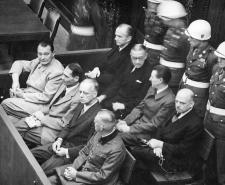
In the sombre months after Allied victory in 1945, a young U.S. Army psychiatrist found himself at the centre of one of history’s most consequential moments. Douglas M. Kelley was assigned as chief psychiatrist to the new prison holding top Nazi leaders, just as the world prepared to judge them at the Nuremberg Trials.
Kelley arrived at the detention centre in Mondorf-les-Bains, Luxembourg in August 1945. The centre was a transformed hotel now housing infamous captives, and soon moved with them to Nuremberg, Germany when the trials began. At 33, Kelley faced a task few could imagine: to assess whether men like Hermann Göring and Rudolf Hess were sane, competent and responsible for their deeds.
In this article, Sky HISTORY profiles Douglas Kelley, the psychiatrist at the Nuremberg Trials, as his story is told in the new film Nuremberg starring Rami Malek and Russell Crowe. We explore his work assessing prolific figures such as Göring and Hess, and how the psychological strain may have contributed to his tragic suicide.
Inside the cells: Interviews, tests and the search for the 'Nazi Mind'
Kelley’s methods were careful and clinical. Over the course of months, the Columbia-trained doctor interviewed 22 of the most powerful surviving Nazi officials. He administered IQ tests, asked them to write autobiographical sketches, and used projective tests such as the Rorschach inkblot test.
His most intensive work centred on Göring, once the Reichsmarschall of the Third Reich – charismatic, flamboyant, intelligent and (as Kelley noted) narcissistic. Kelley observed that despite Göring’s addiction to a painkiller, his cognitive functions appeared intact.
In interviews, Göring displayed charm and intelligence; Kelley reportedly noted an IQ of 138, placing him among the highest-ranking Nazis in terms of raw intellect. But alongside the charm was ego, grandiosity and a chilling detachment from moral reality. Göring spoke with cold conviction about his place in history and his belief that, though he might be executed, future Germans would one day praise him.
In the end, Kelley concluded there was no clinical insanity, no psychiatric illness, no special 'Nazi disease'
. In his view, these men were not deranged monsters; instead, they were disturbingly regular, 'creatures of their environment', capable of unspeakable acts under the correct pressures. He documented his findings in a book published in 1947, titled 22 Cells in Nuremberg.
The burden of insight
Kelley’s verdict was morally uncomfortable, but historically powerful. If these men were sane, then evil was not confined to psychopaths. It could live in ordinary ambition, in ruthless ambition, in obedience to ideology. As he reportedly argued, labelling them insane might absolve them of responsibility. Instead, they must face justice as rational actors.
That insight, the terrifying notion that 'monsters' might be mind-bogglingly ordinary, left a mark on him. Some historians claim this realisation shook his faith in the ability of psychiatry to explain evil.
The final act
Back in the United States, Kelley threw himself into work with the same restless intensity that had marked his time at Nuremberg. He experimented with truth serums, developed drug-based treatments for traumatised soldiers returning from the war, and even assisted police by administering polygraph tests.
But privately, the strain was beginning to show. His personal doctor later described months of treating Kelley for a 'seriously upset stomach', compounded by the stress of his growing professional commitments. It’s unclear how much of this was physical and how much was the cumulative weight of his experiences. But by the end of 1957, he was clearly a man frayed by pressure.

Then, on New Year’s Day 1958, Kelley ingested a cyanide capsule at his home. He died within minutes.
What actually happened in those final moments remains an open question. Some early reports suggested the cyanide might have been a grim memento from Nuremberg. Some even speculate that it could have been linked to Göring, whose own suicide by cyanide had so disturbed the world.
But Kelley’s widow, Alice-Vivienne, and his son, Doug, offered a more grounded view: Kelley kept a home laboratory filled with chemicals, and there was simply no certainty about where the capsule came from or what his intentions had been.
Want more updates on amazing stories like this from history? Sign up to the Sky HISTORY newsletter! Be the first to hear about new TV series, exclusive stories and so much more.


