
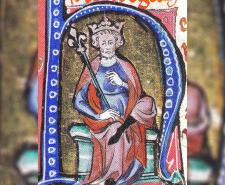
Emma of Normandy: The queen who married two kings
Discover the remarkable life of Emma of Normandy. A queen who married two kings of England and shaped the history of medieval Europe.
Image: Public Domain
Emma of Normandy lived an extraordinary life in a time full of danger, war and power shifts. What makes her story so remarkable is simple. She married two different kings of England, first Æthelred II and later Knut the Great, but still managed to stay powerful through it all.
But her life wasn't just unusual; it helped shape the future of England, Denmark and Norway.
Here at Sky HISTORY, we find the story of Emma's life a truly engaging one. She lived a life of both survival and ambition. Her story is told in more detail in the upcoming series, Knut: The Viking Emperor, airing from Monday 4th May. This article explores how she navigated the brutal politics of her era to leave a lasting mark on medieval Europe.
A strategic beginning
Emma was born around 984 into the powerful Norman family. Her father was Richard I of Normandy, who ruled a region with strong Viking roots. This background would later prove important.
In 1002, Emma married Æthelred II, the king of England. Definitely not a love story, their marriage was all politics. England was under constant attack from Viking raiders, and Æthelred hoped that marrying a Norman princess would strengthen alliances and bring some peace.
When Emma arrived in England, she didn’t fade into the background. She became an active queen, owning land and taking part in royal decisions. This was unusual for women at the time and showed early signs of her strength and intelligence.
A kingdom in crisis
Emma’s first marriage was far from peaceful. Viking attacks continued and things only got worse. In 1013, the Danish king Sweyn Forkbeard invaded England and took control.
Fleeing to Normandy with her children, Emma escaped the chaos. Although Æthelred briefly returned to power, he died in 1016, leaving the kingdom in turmoil.
At this point, Emma could have disappeared from history altogether, but instead, she made a bold and surprising move.
Marrying the enemy
After Æthelred’s death, England was taken over by Knut (also known as Canute), the son of Sweyn Forkbeard. A Viking ruler, he successfully conquered the country, and so rather than resist him, Emma married Knut in 1017.
Her decision might seem shocking, but it was incredibly smart. By marrying the new king, Emma remained queen and protected herself and her children. It was a good arrangement for Knut too. Marrying Emma meant the English people accepted him, since she was already their queen.

This is how Emma became known as 'the queen who married two kings'
. But really, it shows how skilled she was at surviving and staying influential in dangerous times.
Queen of an empire
Emma’s second marriage brought her even greater power. Knut didn’t just rule England. He also ruled Denmark and Norway, meaning that Emma was queen of a vast North Sea empire.
Not just a figurehead, Emma helped govern England while Knut travelled between his kingdoms. She worked closely with the Church, restoring churches and building strong relationships with religious leaders.
By this point, she had become one of the richest and most powerful women in the country.
A mother of kings
Emma’s influence wasn’t just on her marriages. It also continued through her children. With Æthelred, she had Edward (later known as Edward the Confessor), and with Knut, she had HarthaKnut. Both of her sons would go on to become kings of England.

Emma stayed involved in politics even after Knut died in 1035, strongly supported their claims to the throne. She worked to secure power for her family, showing once again how determined and capable she was.
However, her later years were not entirely smooth. When her son Edward became king, their relationship became tense. At one point, he even took away her lands and power, although she later got them back.
Why Emma matters
Emma’s life had a huge impact on several countries.
In England, she helped bridge the gap between Anglo-Saxon and Viking rule. Her marriage to Knut made sure that he was accepted as the new king. She also helped strengthen the Church and royal authority. In Denmark and Norway, her role as queen helped support Knut’s rule across his empire.

Perhaps most importantly, Emma’s Norman background created a lasting connection between England and Normandy. This connection would later lead to one of the most famous events in English history: the Norman Conquest of 1066.
A remarkable legacy
After living through decades of war, change and political struggle, Emma of Normandy died in 1052. She wasn’t just a queen who happened to marry two kings; she was a clever and powerful figure who shaped history.
Her story is one of survival, strategy and influence. At a time when women had very little power, Emma stood out. She didn’t just live through history. She helped create it.
Discover more in Knut: The Viking Emperor from Monday 4th May. Want more fascinating stories from the past brought to life? Sign up to the Sky HISTORY newsletter! Be the first to discover new TV series, exclusive historical insights and incredible true stories from across the ages.


