
Peasants’ Revolt: The rebel women of 1381
As Andrew Garfield’s new film The Uprising highlights the Peasants’ Revolt, we ask why female leaders of the 14th-century rebellion are often overlooked.
Image: Although the Peasants' Revolt is largely seen as a male affair, there were several influential women that should be remembered | Public Domain
A new film is drawing fresh eyes to one of history’s few well-known rebellions to so far get short shrift from Hollywood. We’re talking about the Peasants’ Revolt, which finally gets its due in The Uprising, starring Andrew Garfield as an embattled ploughman in 14th-century England.
The list of real-life historical figures featured in The Uprising reads like a ‘who’s who’ of influential movers and shakers from the period. We get rebel leader Wat Tyler, radical preacher John Ball and royal associates Simon Sudbury and Sir Robert Hales, amongst crowds of other, nameless men.
Watching the trailer for The Uprising, you could easily get the impression that the Peasants’ Revolt was a very blokey affair. However, it’s crucial not to overlook the female leaders who also played their part, only to be subsequently written out of history.
How the Black Death unexpectedly liberated women
The England of the late 14th century had a surprising amount in common with our own time. An apocalyptic cocktail of endless war, financial hardship and erratic weather took its toll on the subjects of the young Richard II. He acceded to the throne in 1377, when England was still recovering from the shock of the plague pandemic known as the Black Death.
The Black Death had ripped through Europe that century, killing about half the English population. With the number of available labourers now significantly reduced, those still around saw their wages soar. Women in particular reaped unique benefits, according to Philippa Gregory, the author of Normal Women: 900 Years of Making History.
Gregory told the Betwixt the Sheets podcast in 2023: ‘They could enter the workforce in ways they hadn’t before because there were not enough workers.’ When authorities started cracking down on work freedoms unleashed by the Black Death, men wouldn’t have been the only ones motivated to fight back.
What sparked the Peasants’ Revolt?
The English public were especially incensed by the Crown’s attempts to impose a new ‘poll tax’
, which both men and women were required to pay. It was also charged at the same flat rate for everyone, taking no account of individual taxpayers’ differing financial situations. When tax collector John Bampton turned up in Essex, he was physically assaulted, setting off a chain reaction of further protests across southeast England.
That was in the summer of 1381, when Wat Tyler, played by Cosmo Jarvis in The Uprising, emerged as the rebellion’s ringleader. When rebels led by Tyler marched on London in June, they selectively attacked property owned by individuals associated with the government and its unpopular policies.
Well-behaved women seldom make history…
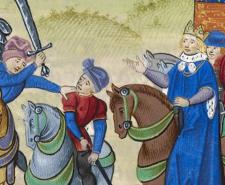
Women instigated much of the violence that erupted in London. Johanna Ferrour led one group that stormed the Tower of London, which Sudbury and Hales had unwisely chosen as a sanctuary. These two were seen as instrumental in the enforcement of the poll tax. Such was the unpopularity of these government figures (Sudbury was Lord Chancellor, while Hales was Treasurer) that Ferrour had them both beheaded. Despite these acts of brutality, there is no evidence that Ferrour was ever convicted for them.
Chief Justice John Cavendish found himself similarly targeted by an angry mob in Suffolk. His chances of escape lay in a boat he was desperately heading for. However, before he got there, another woman – Katherine Gamen – untied the vessel, leaving it to drift from Cavendish’s reach. The stranded judge was subsequently seized upon by his pursuers.
Though Wat Tyler was killed on 15th June after an altercation with the king’s men, effects of the Peasants’ Revolt reverberated far beyond London. The rioters knew that their actions were illegal but, hoping to prevent the law from catching up to them, also sought to destroy legal documents. In Cambridge, such documents were burned. One woman called Margery Starre reportedly spread the resulting ashes while declaring triumphantly: ‘Away with the learning of clerks, away with it!’

Why has history forgotten the rebel women of 1381?
At a time when women had few legal rights, they were also rather less accountable to the law than their male counterparts. For example, married men were deemed ultimately responsible for keeping their wives in line. How much incentive would courts have to name and shame female wrongdoers if the legal system wasn’t supposed to directly punish them anyway?
For more on history's forgotten rebel women, sign up to the Sky HISTORY newsletter. Every week, you'll receive the latest articles, episodes and more delivered straight to your inbox.


