
Hunting for Nazi Gold: A historian details his personal hunt for stolen treasure
From buried loot to missing billions, historian Guy Walters investigates the truth behind Nazi gold and the treasure hunters still searching for it today.
Image: Historian Guy Walters chases legends of hidden Nazi treasure in a new Sky HISTORY series | The Last Hunt For Nazi Gold

In this guest article, historian, TV presenter and journalist Guy Walters describes the search for stolen Nazi treasure he undertook while filming The Last Hunt for Nazi Gold for Sky HISTORY. He describes the experienced treasure hunters him and his co-host Justine Ostrowska encountered and the theories of varying plausibility they shared.
To find out if Guy and Justine were able to uncover any lost gold, watch The Last Hunt for Nazi Gold on Sky HISTORY from Monday, 30 March at 9pm.
I have been appearing in history documentaries for the best part of twenty years. Nearly every year, I get a call, normally from some poor junior producer, who tells me their company wants to make a documentary about Nazi gold, and if so, did I know where they might find some?
It’s at that point that I ask them to think about their question very carefully. If, I say, I did know the location of a load of Nazi bullion, do you think I would tell them? I then add that if they really want to find themselves some Nazi gold then they should just knock on the door of any Swiss bank and ask for a shufti in the vaults. End of call.
So far, so knowing of me, so cynical. And then, in January 2023, my position changed with an intriguing release from the Dutch national archives – a real life treasure map, hand-drawn by a Nazi paratrooper, revealing where he and his comrades had buried a load of loot they had stolen from a bank towards the end of the war. The map even had a red X that marked the spot, outside a village called Ommeren. Okay, so this wasn’t technically Nazi gold, but it was as near as dammit – actual treasure looted by actual Nazis! That would do nicely, and might even make a fun short film.
And so, at 5 a.m. the following day, accompanied by my cameraman son William and his mate Magnus dragooned in to do the sound, I set off to the middle of the Netherlands from deepest Wiltshire, the boot of my creaking Land Rover loaded with picks and spades. All my grown-up historian’s wariness had melted away – I was literally on a hunt for Nazi gold.
We arrived around lunchtime, and after overlaying the rough treasure map on a satellite view, we made our way to a spot near a wood, where we came across a retired businessman called Jan, who agreed that surely we were pretty darn close to that tantalising red X.
So out came my pick, and I dug. And dug. And dug. And, I sort of knew it all along, up came nothing. All I had to show for my labours were some very muddy jeans. With the light fading, we called it a day, and rewarded ourselves with liquid gold in the form of the local brew.
Despite my failure, I realised that the subject of Nazi gold might at least bring some TV treasure, rather than the actual stuff. After all, the Sunday Times even dedicated the whole page of its news section to our adventures. I was convinced there was a series in this, and soon the good folks at Sky HISTORY had commissioned me to present a six-part series called The Last Hunt for Nazi Gold, which will be on your screens from 30 March at 9pm for six weeks.
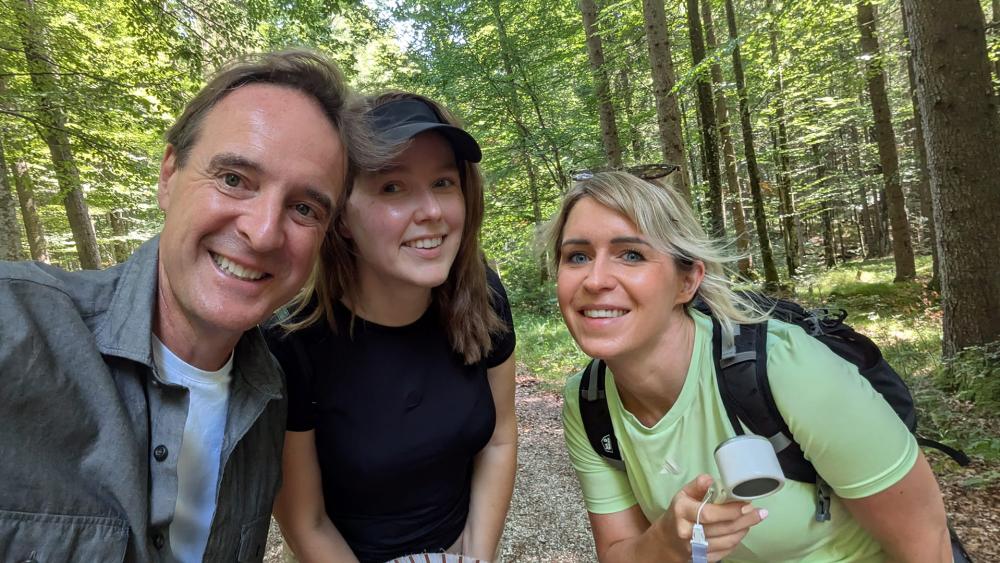
Image: Hosts Guy Walters (L) and Justine Ostrowska (C) are joined on their expedition by several dedicated treasure hunters, including Cornelia Ostler (R) | Guy Walters
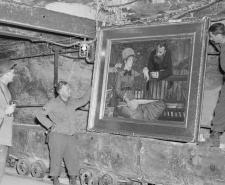
As well as looking for Nazi gold, my co-host Justine Ostrowska and I suspected there would be more fun in broadening the remit, and so we included other treasures looted by the Nazis, such as the Amber Room, the fabled Nazi gold train, and missing paintings. We also have as much fun meeting the wonderful – and sometimes weird – characters who are obsessed that such-and-such a spot contains billions of pounds of treasure, as we do in actually doing the digging ourselves.
But despite all the jocularity, the story of Nazi gold is a serious one. The Third Reich was undeniably a gangster state, and like all gangsters, the Nazis stole, and stole big time. Every country they invaded was plundered, its gold, silver, and other priceless treasures taken to Germany. This is not to forget the gold stolen from the Jews, often gruesomely wrenched out of the mouths of so many corpses. It is hard to give a precise figure, but in today’s money, it is estimated that the Nazis stole some £8.5 billion worth of gold, of which some £1.5 billion to £3 billion was taken from Jews. This does not count the other treasures stolen, the value of which runs into the hundreds of billions.
The first obvious question is this: Where did it all go?
The good news is that a lot was recovered. About half the bullion was found by the Americans in a massive mine called Merkers in Thuringia, while much other gold – and indeed silver – was found in banks in Berlin and all around Germany. Another billion pounds worth was unearthed in the hills above Lake Walchensee in southern Bavaria, where it had been taken by mules led by Nazi soldiers at the end of the war.
And now for the next obvious question: How much is missing?
It is impossible to give a reliable answer. Most sensible historians suspect the figure is very low, and if any gold is missing then it is extremely likely to lie in bank vaults in Switzerland. It is well known that many senior Nazis spirited their wealth into the country towards the end of the war, but thanks to the notorious secrecy of Swiss banking laws, to establish just how much is there – if any – is very difficult, to put it mildly.
Those of a more conspiratorial bent firmly believe that many millions of pounds worth of gold and artworks still lie hidden, and it is these characters that Justine and I met on our month-long road trip around central Europe.
Armed with proper treasure-hunting equipment, we joined forces with those who have been hunting Nazi gold and treasure for decades. Some of those we met more than raised our eyebrows, while others were far more plausible and made me reevaluate my scepticism.
Among the latter was the charismatic Cornelia Ostler, who has been treasure hunting across Germany nearly all her life. Cornelia’s speciality is looking for the gold that she believes is still missing above Lake Walchensee. While many believe that it was all recovered, Cornelia is adamant that there is still some to be found, and her copious documentation and archive material is undoubtedly impressive – and pretty convincing.
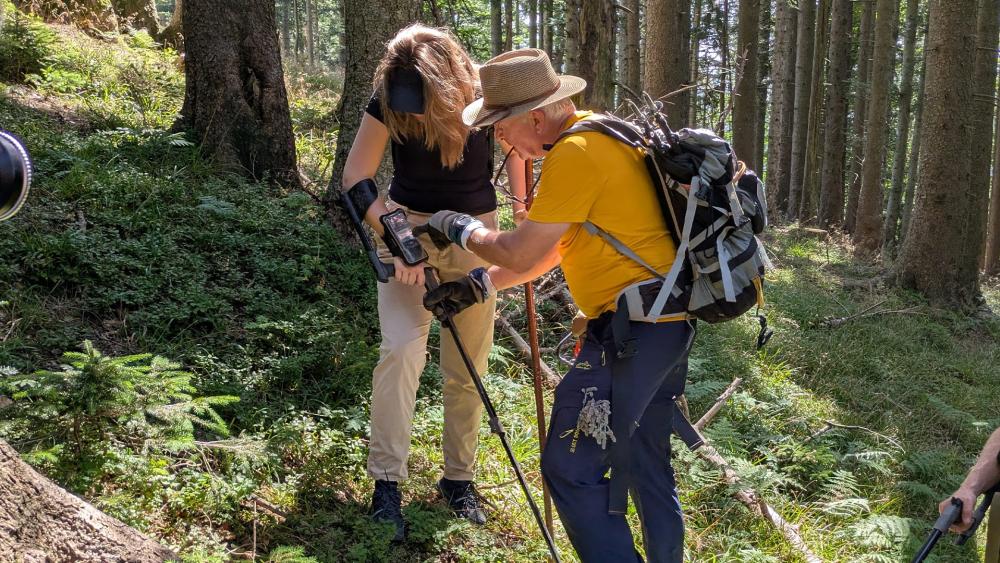
Image: Jurgen Proske helps Justine Ostrowska with a metal detector | Guy Walters
Also plausible was a friendly German called Jurgen Proske, with whom we spent a sweltering day high up a mountainside in a secret location in southern Germany. Like Cornelia, Jurgen has been hunting all his life, and while he may not have found any gold, he has certainly found all sorts of Nazi-era relics, some of which are of much historical interest, and even have some monetary value. Lending Justine his far more professional metal detector, I am delighted to report that we did indeed find something, and we found it quickly. I am not going to give away any plot spoilers, but all I can say is that Justine has not yet replaced her old Porsche.
Then there are the hunters whose tales are just a little too tall for my taste. One of our ports of call was Wałbrzych in south west Poland – a town whose name I still cannot pronounce – where it said that a whole train of Nazi gold is hidden in a hillside. The leading proponent of this theory is Piotr Kopr, who says that he has spent the value of a second home in looking for the train. He has commissioned extensive ground radar surveys, and while the endless readouts and bits of data all seem very impressive, I’m not sure they scream ‘Nazi Gold Train’ at me.
Nevertheless, we did go and have a look, and you will have to wait and see what we found.
Then there was Burkhardt List, a historian and inveterate treasure hunter, who is absolutely determined that a stash of artwork worth hundreds of millions is located deep beneath a clearing in a wood near the Czech-German border. I liked Burkhardt, but I didn’t care much for his theory. When I asked him what was stopping him from trying to arrange an excavation he looked at me darkly, and informed me that the ‘Fourth Reich’ was against him.
Ultimately, the biggest lesson I learned from my Last Hunt for Nazi Gold was that you never know. Sure, it is easy to be sceptical, but there are enough sensible people who think there might be a bar or two of gold kicking around some mountainside. If they ever found some, the decent thing to do would be to give it back to those from whom it was stolen. What’s important to remember is that the story of Nazi gold, while entertaining on one level, is also very dark indeed.


